Amid pressure on goods exports due to high US tariffs of 50 per cent and the trade deal with Washington still in play, India is pushing to complete negotiations for a trade deal with the European Union by next month and has asked the legal team working on the text of the deal to refrain from taking leave before signing the trade deal with the EU, The Indian Express has learnt.
With an EU delegation expected to visit India on December 3, the two countries have accelerated rounds of negotiations, and a virtual stocktaking meeting between Commerce Secretary Rajesh Agrawal and EU Directorate-General for Trade Sabine Weyand took place on Friday as the two partners enter the final round of negotiations.

Even though 10 of the 23 chapters have been closed, key issues, notably related to rules of origin and market access that include agriculture, remain unresolved, said two people familiar with the developments. The two countries reached an agreement on sanitary and phytosanitary (SPS) measures, which means agreement on the use of different methods of control, inspection and approval procedures to verify compliance with pre-agreed standards that impact food products.
As the deadline approached, the two partners probably also abandoned a few sensitive chapters, including one on state-owned enterprises, as New Delhi was not in agreement to put the same on the negotiating table. The state-owned enterprise chapter of a trade agreement typically deals with the rules and governance surrounding companies that are partly or fully owned by a government, covering their commercial activities and competitive neutrality.
On the issue of the carbon tax that the EU is expected to implement from January 1, India has introduced a “rebalancing” provision, as the EU is unlikely to be willing to grant a concession to Indian products. The rebalancing provision would mean that if Indian products face restriction in access to the EU market, India would subject European products to restrictions to the same extent.
The Indian Express had reported that India had proposed a similar provision in the trade deal with the UK to ensure that when London introduces its version of the Carbon Border Adjustment Mechanism (CBAM), it does not impact the concession India gets under the trade deal. The rebalancing mechanism has also been introduced as the carbon tax legislation aims to include more and more products in the future.
The carbon tax, which will ensure that carbon-intensive goods imported into the EU will incur a carbon cost from January 2026, is seen by several developing countries as discriminatory and contrary to international environmental law. Brazil, China, India and South Africa have expressed serious concerns about CBAM in World Trade Organization (WTO) forums, and Russia initiated a formal dispute on May 12 of this year.
Story continues below this ad
A statement issued in October by the Ministry of Trade and Industry said there was intensive engagement to explore possible landing zones on outstanding issues, and there was also good discussion on India’s concerns over non-tariff measures and new EU regulations.
“During the negotiations, Commerce Minister Piyush Goyal highlighted the need for preferential treatment for India’s key demands, particularly those related to labor-intensive sectors. Both sides agreed to work closely to finalize non-sensitive industrial tariff lines. They also agreed that issues related to steel, automobiles, CBAM and other EU regulations still require further discussions as they are more sensitive,” the statement said.
Official trade data shows that steel and aluminum shipments to the EU have already fallen by 24.4 percent – from $7.71 billion to $5.82 billion in FY25 compared to the previous financial year. This is concerning as Indian products already face 50% tariffs on steel and aluminum in the US market.
The EU is India’s largest trading partner, accounting for €124 billion in goods trade in 2023, or 12.2% of total Indian trade. India is the EU’s 9th largest trading partner, accounting for 2.2% of the EU’s total trade in goods in 2023. Trade in services between the EU and India reached €59.7 billion in 2023, up from €30.4 billion in 2020.
Story continues below this ad
After the phone call on September 4, in a message on
Ajay Srivastava, a former trade official and founder of the Global Trade Research Initiative (GTRI), said that unlike the United States – whose recent 50% tariffs on steel and aluminum are harsh but clearly defined – the EU’s trade barriers are complex and opaque. He added that a fair FTA with the EU should address measures such as the carbon tax.
Srivastava said the CBAM, once fully implemented, would result in an import tax of 20 to 35 percent on Indian companies and the industry will have to share all factory and production details with the EU. “Large companies may have to run two production lines: expensive but greener lines for making products for export to EU countries, and normal lines for the rest of the world,” Srivastava said.
Aside from the carbon tax, other sensitive issues include whiskey, cars and automobiles. Although access to the UK market was granted in stages, experts said volumes in the EU case would be much higher and therefore negotiations on market access for these products would be more complicated.
Story continues below this ad
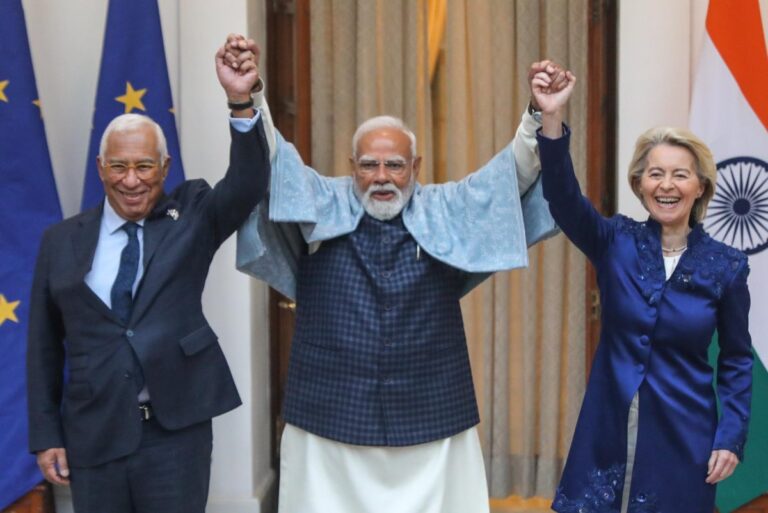
In response, Costa and von der Leyen said: “Looking ahead, we plan to agree on a joint strategic agenda at the next EU-India summit, as early as possible in 2026. We also remain fully committed to concluding the Free Trade Agreement negotiations by the end of the year. To achieve this, progress is needed now.”
About The Author