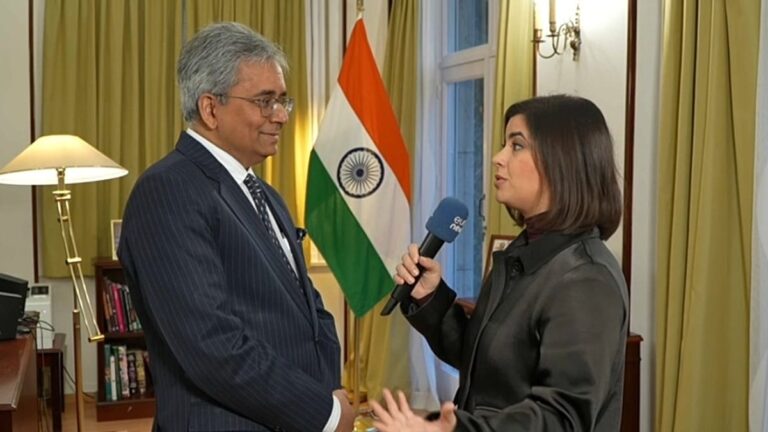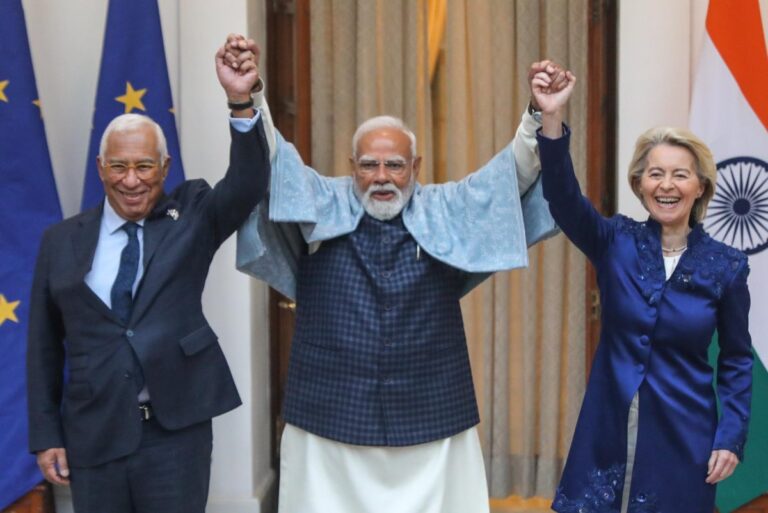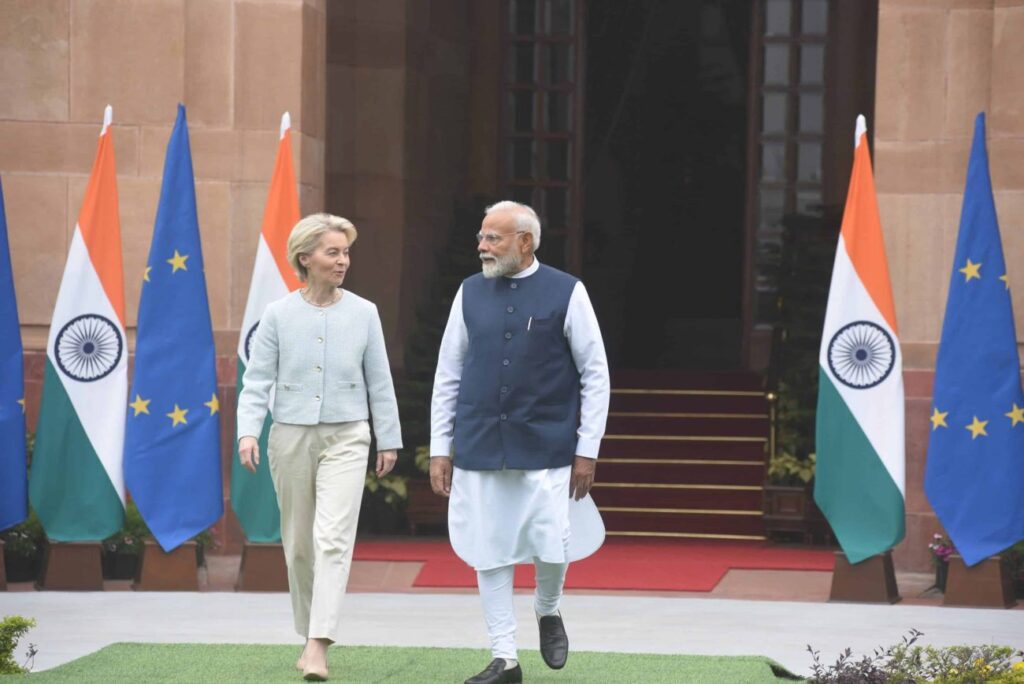
The European Union and India are intensifying their negotiations towards a strategic free trade agreement. The agreement aims to strengthen investment, facilitate trade in goods and services and create new economic opportunities, while balancing European industrial interests with India’s development priorities. Interview with Mohit Anand.
Dr. Mohit Anand is Professor of International Business and Strategy at Emlyon Business School, France.
Conflits is the first French geopolitics magazine. Some articles are now available in English — you can find them here.
What are Europeans looking for and what do Indians want? Which products will benefit both parties?
Both India and the EU are major global economic powers. India recently overtook Japan to become the world’s fourth largest economy. With its vibrant democracy, growing middle class and young demographics, India represents a vast market opportunity for the EU, both in terms of trade and investment. More than 6,000 European companies are already present in India.
The proposed FTA could further increase foreign direct investment opportunities for European companies seeking new growth markets. For India, the deal promises not only capital inflows but also access to cutting-edge technologies, which aligns closely with the government’s ‘Make in India’ initiative, which aims to boost domestic manufacturing, create jobs and promote best practices.
Conversely, the EU, as a leading economic bloc, offers India a large and stable market across 27 member states. Lower or zero tariffs would make Indian exports of goods and services more price competitive, putting them on par with products from ASEAN, China or Turkey.
Currently, the EU accounts for almost 17% of India’s total exports, while India accounts for around 9% of the bloc’s global exports. Bilateral merchandise trade stood at $136.5 billion in 2024-25, including $75.85 billion in exports and $60.68 billion in imports. Trade in goods between the two partners has increased by almost 90% over the past decade, while bilateral trade in services reached $59.7 billion in 2023.
Europe is seeking to expand market access for products such as machinery and transport equipment, automobiles, wines and spirits and chemicals. India, for its part, is looking to increase its exports of ready-made garments, pharmaceuticals, steel, petroleum products and electrical machinery.
Both sides have worked intensively in recent years to conclude a comprehensive, balanced and mutually beneficial agreement as quickly as possible.
The Indian auto industry is very concerned about this deal. For what?
The EU has demanded substantial reductions in Indian customs duties on automobiles and their components. Fully assembled cars currently face import duties of 60%, which Brussels considers protectionist, while EU customs duties on Indian cars are just 6.5%.
Indian manufacturers fear that steep tariff cuts could flood the domestic market with European vehicles, undermining local investments and the Make in India campaign. There are also concerns that auto components are being imported at preferential rates, which could weaken domestic suppliers.
However, it’s not all negative. India will likely have to make some concessions on tariffs, but it could also encourage European automakers to use India as a low-cost production and export hub, taking advantage of its vast demand and capacity. This could attract new investments, technology transfers and collaboration between European and Indian companies, thereby fostering innovation, particularly in the area of affordable vehicles, electric mobility and the two-wheeler segment.
Indian agriculture remains very sensitive. How could it adapt to a treaty with Europe?
As in Europe, agriculture in India is both a sensitive and strategic sector that neither party is prepared to completely liberalize. About 45% of India’s workforce is employed in agriculture and allied activities. The government provides substantial subsidies in the form of discounts on fertilizers and equipment and by purchasing crops for public food distribution programs that benefit 60-70% of the population, at a cost of approximately $12 billion in fiscal year 2025. Food security is therefore at the heart of India’s political, economic and social priorities.
Despite its large population, India is a net exporter of food, thanks to improvements in agricultural productivity, logistics and storage. However, the risk of flooding the market remains, for example due to European dairy products, or global competitors such as American soya, Brazilian sugar cane and Chinese pork. Climate change and unpredictable weather conditions only add to the uncertainty.
India has therefore been very cautious about opening its agricultural markets, both with the EU and with other partners such as the United States. Rapid liberalization could expose local farmers to heavily subsidized European products. The EU, meanwhile, is seeking to reduce tariffs on products such as dairy, meat and poultry.
A balanced compromise is therefore essential, which respects the sensitivities and strategic imperatives of each party.
Are there protests in India against this treaty? And what are Europeans worried about?
There are no significant protests or widespread opposition to the proposed FTA from either side. For India, the deal would expand its trade footprint in a region that already accounts for 17% of its exports. It would also help diversify trade amid global geopolitical uncertainty, particularly given the recent protectionist stance of the United States under President Trump.
India has actively pursued FTAs in recent years, striking deals with the United Arab Emirates, Australia, the United Kingdom and the European Free Trade Association, while negotiating others with the United States, Gulf states, New Zealand and the Eurasian Economic Union. The EU, for its part, would benefit from better access to the fast-growing market of India, now the world’s fourth-largest economy, and would benefit from its expanding middle class and investment potential.
However, investment remains a major point of divergence. Discussions on energy and raw materials, including infrastructure and non-tariff barriers related to renewable energy, were sidelined after the 11th round of negotiations. The EU has also raised concerns over quality control orders imposed by India, which it sees as barriers to market access.
India, meanwhile, is expected to push for easier access for its skilled professionals to work in Europe, a politically sensitive issue given current debates over immigration within the EU.
Despite these challenges, both sides recognize the strategic necessity of the agreement, not only to strengthen bilateral trade and investment, but also to diversify their economic partnerships in an increasingly uncertain global environment.
The next round of negotiations between India and the EU will take place in Brussels on October 27-28 and will cover key areas of the proposed FTA, including market access, non-tariff measures and regulatory cooperation. The meeting will review progress made so far and identify areas requiring further convergence.
Find Conflicts in English by clicking here.
About The Author