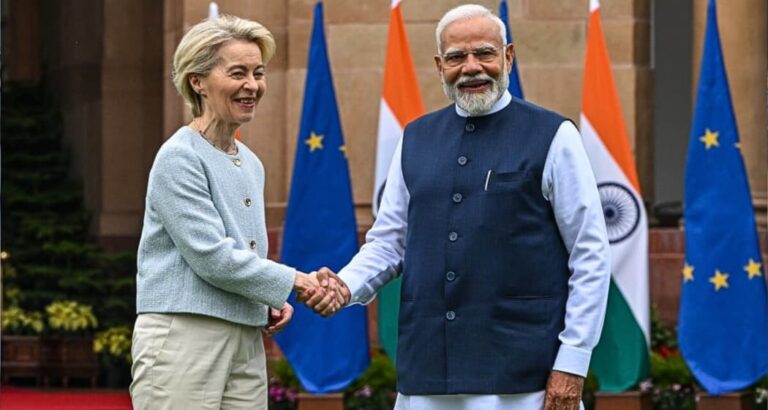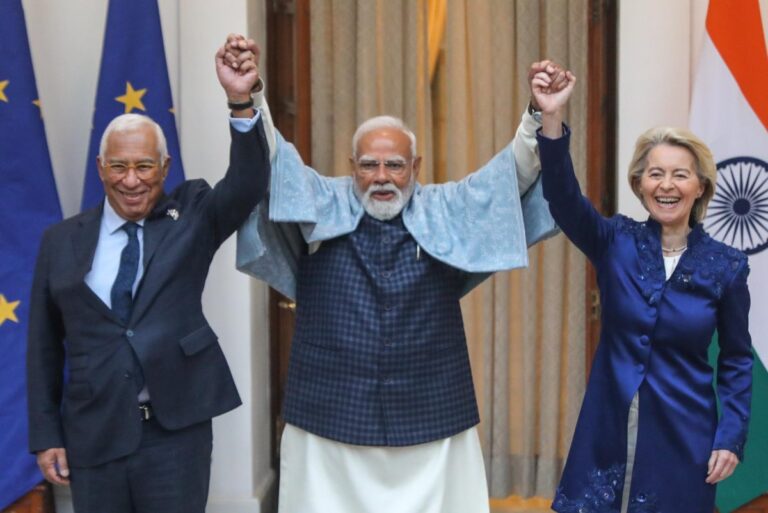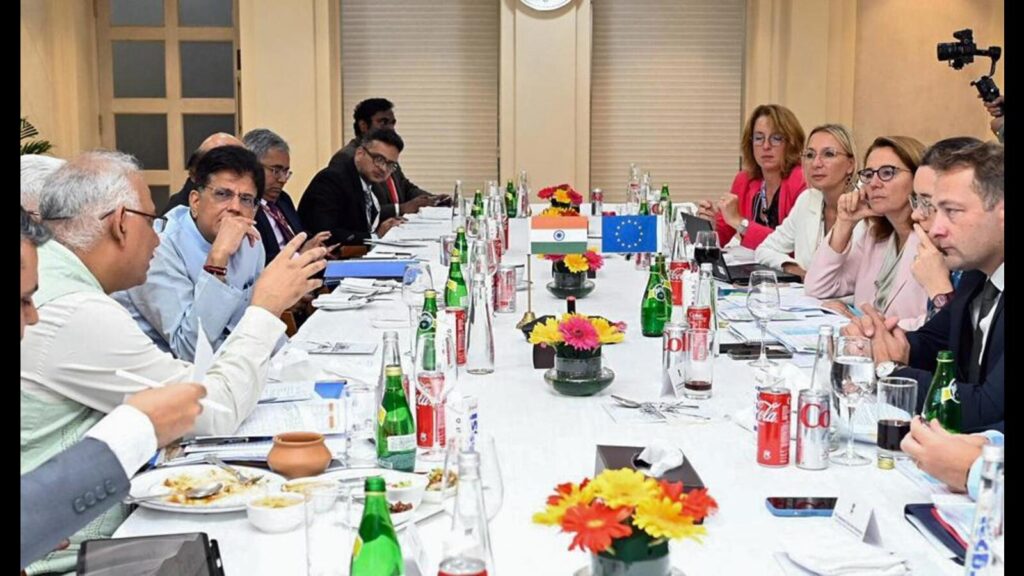
As the Free Trade Agreement (FTA) negotiations between India and the European Union (EU) draw to a close, we could see a drop in the EU’s already low tariff rates. After the recent India-EU bilateral meeting, the Indian government indicated that the EU regulations on Carbon Border Adjustment Measures (CBAM) and other regulations require further discussions as these issues are more sensitive. The real test of the FTA will be its ability to respond to CBAM and other complex EU regulations that increase the costs of effective market access. While claiming to be in the interest of the environment, these EU measures are in reality aimed at maintaining the cost competitiveness of its national industry.

When the EU announced the EU-India Strategic Agenda in September, it claimed that carbon prices paid under India’s upcoming Carbon Credit Trading Scheme (CCTS) would be deducted from the CBAM price. This was simply to state the obvious: the EU CBAM regulation allows all countries to deduct the carbon price paid in any exporting country, subject to its verification by the EU. The worrying aspect was the EU’s implicit suggestion that only the concrete price paid under the CCTS could be deducted from the CBAM price, and not the various other costs and taxes paid in India, including excise duties and fuel levies, mandatory requirements under Indian law for the purchase of defined portions of renewable energy, or the purchase of renewable energy certificates in lieu thereof.
It is also important to compare this with the EU’s approach to the US in the Framework Agreement on Reciprocal, Fair and Balanced Trade announced in August, in which the EU “committed to working to provide additional flexibilities in the implementation of the CBAM”. Any special treatment granted by the EU to the United States would go against the WTO’s most favored nation (MFN) principle, which prohibits countries from playing in favor of favored countries. EU actions will therefore need to be closely monitored.
Indian exports of aluminum and steel are those most affected by the EU CBAM. The Government of India recently notified the first legally binding Greenhouse Gas Emission Intensity (GEI) Target Rules, 2025, under the CCTS for four high-emitting sectors: aluminum, cement, chlor-alkali and pulp and paper. The GEI targets for iron and steel are also expected to be notified soon. Exchanges under CCTS will begin in October 2026. However, CBAM compliance costs will have to be taken into account from January 2026 itself. This leaves a gap of 10 months during which even minor adjustments under CCTS will make no difference to Indian exports.
Initial estimates indicate that the price of carbon dioxide determined by the CCTS will likely be less than €10. In contrast, the EU carbon price under the EU Emissions Trading System (EU ETS) is much higher, typically ranging from 60 to 90 euros per tonne of carbon dioxide, and is expected to rise further as CBAM is implemented. This price gap is likely to persist due to differences in market maturity, target sectors and regulatory enforcement. As a result, Indian exporters will face higher CBAM costs when trading with the EU, despite complying with both domestic legislation and international climate obligations. It’s unfair. It is important to note that emissions are a factor of production, just like labor. Equalizing the costs of factors of production sets a troubling precedent for trade agreements.
The CBAM is not the only problematic instrument for exporters to the EU; it is part of a series of measures adopted as part of the “EU Green Deal”, a cocktail of regulatory instruments. The European Union Deforestation Regulation (EUDR) requires companies trading in livestock, cocoa, coffee, oil palm, rubber, soy and timber, as well as derived products, to conduct extensive due diligence across the value chain to control forest degradation.
The EU’s Corporate Sustainability Due Diligence Directive (CS3D) and Corporate Sustainability Reporting Directive (CSRD), described by the United States as “serious and unjustified regulatory overreach”, impose an obligation on companies to exercise due diligence, track and report on environmental and human rights compliance, not only in their own companies, but in entities throughout their upstream and downstream supply chains. Compliance obligations will be immense, which is why the United States has asked the EU to exempt American companies from their scope.
The EU Green Deal also highlights the abject failure of multilateral trade rules (WTO) and multilateral climate change rules (UN Framework Convention on Climate Change and Paris Agreement) to address issues at the interface of trade and the climate crisis. To address this, Brazil has proposed the creation of an open coalition for carbon market integration and a new global forum to study how climate rules interact with trade – focusing particularly on harmonizing carbon markets, addressing trade barriers arising from climate policies, and promoting inclusive decarbonization. It also considers income redistribution mechanisms to ensure a fair transition to a low-carbon economy by channeling benefits to low-income countries. India should consider co-leading these efforts, encouraging broader participation from the Global South to contribute to a more just and equitable green transition globally.
Meanwhile, in FTA negotiations with the EU, India must strike the right balance to ensure that the strategic relationship is based on mutual respect and fairness, as well as adherence to multilateral principles. The environment and climate crisis are a global concern, and measures designed solely to keep European businesses competitive will not only fail to deliver real solutions, but will also risk undermining multilateral solutions.
RV Anuradha is a partner at Clarus Law Associates, New Delhi, and Prachi Priya is an economist based in Mumbai. The opinions expressed are personal
About The Author