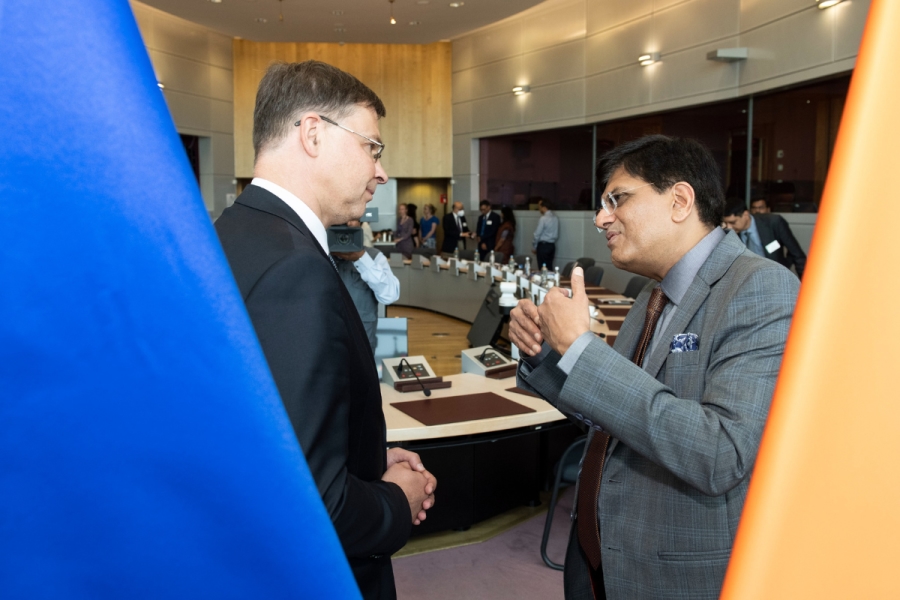
Commerce and Industry Minister Piyush Goyal held a key meeting on Wednesday (October 22) with EU Trade Commissioner Maros Sefcovic to discuss these unresolved issues in the proposed India-EU Free Trade Agreement (FTA).
Goyal described the engagement as “productive”, focused on positively resolving outstanding issues, and said it was a preparatory step ahead of his planned visit to Brussels next week, aimed at giving fresh impetus to the negotiations.
India and the European Union (EU) have agreed to maintain continued engagement at the level of chief negotiators as the deadline for their Free Trade Agreement (FTA) approaches, following the 14th formal round of negotiations concluded in Brussels a few weeks ago.
Despite this sustained attention, a major breakthrough continues to elude both parties, according to a Financial Express report.
The European Commission (EC) has confirmed that, although no further formal rounds are planned, discussions at the political level will continue alongside “intensive and continuous” negotiations at the technical level.
Commerce and Industry Minister Piyush Goyal is expected to visit Brussels later this month to inject fresh impetus into the stalled negotiations.
During the October 6-10 meeting, negotiators exchanged views on the goods trade chapter and market access offers, but without substantial progress.
Both parties outlined their expectations in terms of tariff liberalization, red lines and flexibilities, particularly with regard to the pace and scale of tariff reductions.
The EU is pushing for significant reductions in tariffs on automobiles, medical devices, wine, spirits, meat and poultry, as well as the adoption of a strong intellectual property framework.
India, meanwhile, is seeking duty-free access for labour-intensive products and emerging sectors such as automobiles and electronics, while raising concerns over the EU’s looming Carbon Border Adjustment Mechanism (CBAM), which could impose new taxes on imports of steel, aluminum, cement and fertilizer from January 2026.
In trade in services, the EC noted that very few differences remained, with the text being finalized.
The chapters on sanitary and phytosanitary measures (SPS) and technical barriers to trade (TBT) recorded constructive progress, while significant gaps persist in sustainable trade, development and investment.
Indian officials also remained in Brussels to resolve disputes over rules of origin, which determine the domestic value added required for concessional tariffs.
The India-EU FTA, launched in June 2022, comprises 23 chapters, including trade in goods, services, investment, intellectual property rights and sustainable development, with an agreement already concluded on six chapters.
Please click here to add Swarajya as a preferred and trusted news source on Google
Also Read: Kerala Coastal Highway Project: Land acquisition process begins in Thirurvananthapuram district
About The Author