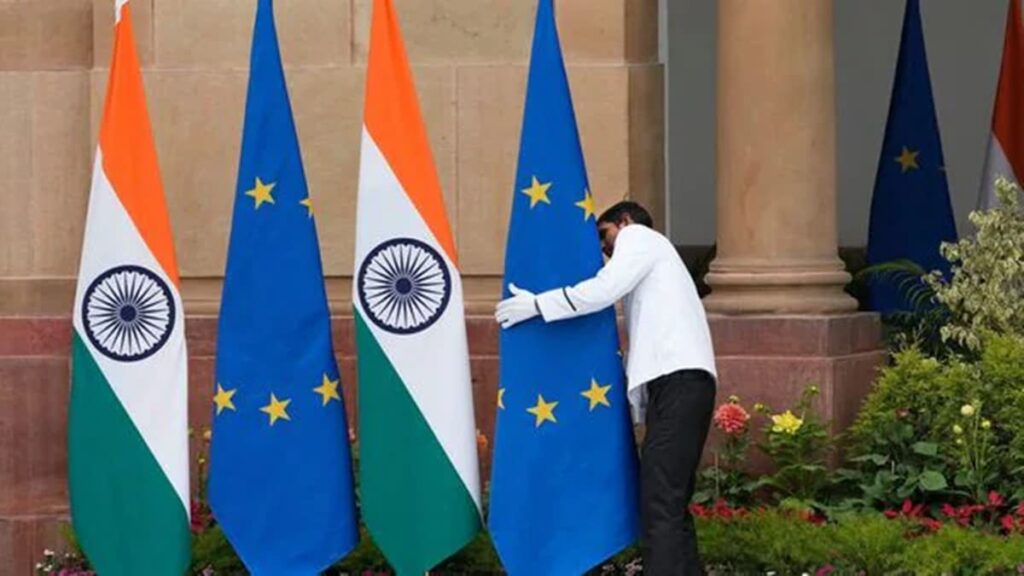
India and the European Union (EU) will now remain permanently engaged at chief negotiator level as the deadline for a free trade agreement approaches, and real progress remains elusive. However, there will be no more formal rounds of negotiations after the 14thth concluded recently in Brussels.
In addition to this “intensive and continuous” engagement, negotiations at political level will continue, the European Commission said in a press release.

Trade and Industry Minister Piyush Goyal will be in Brussels at the end of the month to give a boost to the negotiations.
During the 14th round of negotiations held from October 6 to 10, discussions on trade in goods allowed for a constructive exchange on the text of the chapter on trade in goods and market access offers, but did not result in any significant progress.
Concerning access to the goods market, the two parties made known their expectations in terms of tariff liberalization, red lines and flexibilities, both on the levels of liberalization and on the stage of tariff dismantling.
In addition to demanding significant reductions in tariffs on automobiles and medical devices, the EU wants reduced taxes on other products such as wine, spirits, meat, poultry, as well as a strong intellectual property regime.
India’s demands in the negotiations are duty-free access to its labor-intensive imports and emerging sectors like automobiles and electronics. Another concern for India in the negotiations is the imposition of a carbon tax by the EU on imports of steel, aluminum, cement and fertilizers from January 2026. The tax imposed under the Carbon Border Adjustment Mechanism (CBAM) could pose an additional barrier to Indian exports while tariff barriers are further reduced.
In trade in services, there remain very few areas of divergence and the texts of the agreement are close to being finalized, the EC said.
During the round, the chapter on sanitary and phytosanitary (SPS) measures was concluded in principle while progress was made on the chapter on technical barriers to trade. SPS sets standards for food safety, plant and animal health. In a trade agreement, the parties agree on common standards for the safety of products traded.
TBT deals with standards for products permitted in a country. In a trade agreement, the standards applicable to each partner are explicitly defined.
The area where substantial differences remain is trade and sustainable development. Even in the investment chapter, substantial differences remain. On sustainability, India’s concerns over the introduction of a carbon tax through the Carbon Border Adjustment Mechanism (CBAM) and other related environment-related regulations remain.
To bridge the gap in positions on the rules of origin chapter, the team of Indian officials remained in Brussels for the negotiations. The rules of origin agreement specifies the quantum of domestic value added that a product must have to qualify for concessional tariffs under an FTA.
Negotiations on the India-EU FTA began in June 2022. The FTA covers 23 policy areas or chapters, including trade in goods, trade in services, investment, sanitary and phytosanitary measures, technical barriers to trade, trade remedies, rules of origin, customs and trade facilitation, competition, trade defense, government procurement, dispute resolution, property rights intellectual property, geographical indications and sustainable development. Agreement on six of these chapters has already been reached.
About The Author