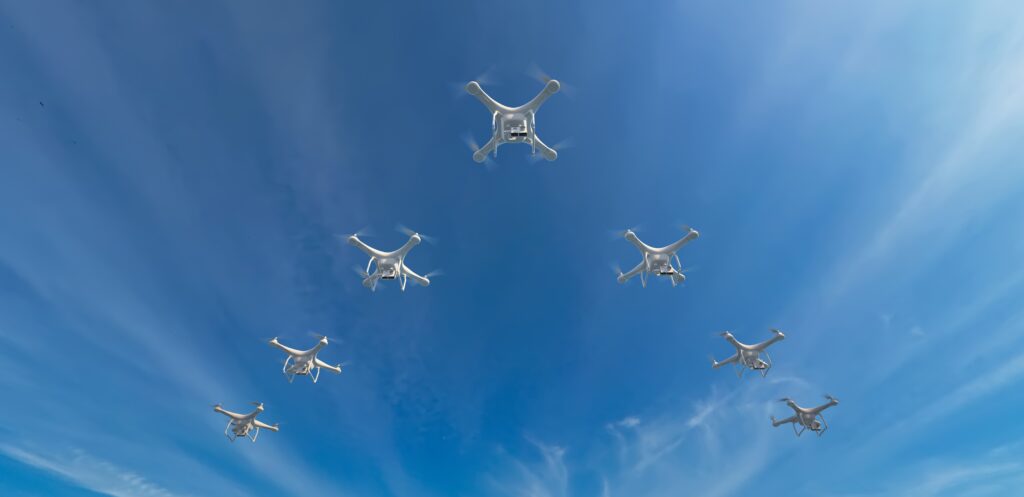
New Delhi, October 15 — The European Union (EU) and India organized a first anti-terrorism training of its kind from October 13 to 15, 2025 to protect critical infrastructure and vulnerable targets from emerging threats from unmanned aerial systems (UAS) or drones as they are commonly known.
The rapid proliferation of unmanned aerial systems (UAS) and their misuse by state and non-state actors poses serious security challenges. Commercial drones have advanced rapidly in technology and accessibility, making them inexpensive and adaptable. Violent extremists have exploited these devices for purposes ranging from surveillance to carrying out attacks.
The three-day exercise brought together senior officers, instructors and technical experts from India National Security Guard (NSG) and the EU High Risk Security Network (HRSN)and focused on the use of advanced UAS and counter-UAS (C-UAS) capabilities. The peer-to-peer activity blended tactical and technological training, culminating in a joint exercise designed to strengthen interoperability and lay the foundation for future collaboration. It also strengthened mitigation skills and familiarized participants with deployment models for major events. Participants also deliberated on the future trajectory of drone threats, including swarm and autonomous systems and the need for advanced detection and neutralization technologies such as artificial intelligence, sensor fusion, directed energy and kinetic countermeasures.
The EU HRSN – a specialized European platform of 28 units from 21 European Union member states – brought a team of UAS and C-UAS instructors and technical experts to Manesar, Gurugram. India’s elite counter-terrorism force NSG, under the Ministry of Home Affairs, conducted the training with its extensive operational experience in detecting, tracking and neutralizing hostile drones.
Special Forces training on UAS counterterrorism tactics in an urban environment, combined with a joint tactical simulation exercise, allowed NSG and HRSN units to test and strengthen their real-world response capabilities. The activity will result in writing standard operating procedures for integrated drone and counter-drone operations in various contexts, and an engagement decision matrix tailored to protect mass gatherings and critical infrastructure.
HE Hervé Delphin, Ambassador of the European Union to India, said: “This joint training demonstrates how the EU and India are turning commitment into action, working side by side to keep our citizens safe. Like India, the EU and its Member States have been directly exposed to direct and deliberate drone threats. These threats are evolving rapidly, under hybrid tactics. Only rapid and coordinated responses will allow us to stay one step ahead. Hence the importance of such joint training. seminar. »
Demonstrating how counter-terrorism cooperation moves from dialogue to action, the event was organized by the EU Delegation to India in cooperation with the NSG and facilitated by the EU project ESIWA+ (Strengthening Security Cooperation in and with Asia and the Indo-Pacific).
The initiative is based on Visit of the College of Commissioners to India in February 2025 and the recently announced Joint communication on a new EU-India strategic agendawhich prioritizes deeper collaboration in the fight against terrorism. This training follows the India-EU Track 1.5 Roundtable on Countering Terrorist Exploitation of UAS held in February 2024. The activity aligns with the EU Indo-Pacific Strategy and builds on the ongoing counter-terrorism dialogue between the EU and India.
EU-India cooperation in the fight against terrorism:
The EU and India regularly participate in counter-terrorism dialogues, which contribute to their technical cooperation efforts in this area. The most recent dialogue, the 15th edition, took place in Brussels on September 9, 2025.
In February 2022, the EU and India organized their first joint workshop on terrorist content online, following up on the counter-terrorism dialogue held in November 2020. This online workshop addressed the urgent issue of terrorist exploitation of the Internet, while exploring innovative prevention campaigns and interventions. Since then, the EU-India Counter-Terrorism Dialogue has continued to prioritize the regulation of terrorist content online, elevating it to the top two priorities during the March 2022 debate. This crucial topic was revisited and deepened during the 2024 EU-India Counter-Terrorism Dialogue, demonstrating the shared commitment of both regions to confront this evolving threat. This point was again at the center of attention during the recently concluded visit of the College of Commissioners to India and in the recently announced joint communications.
EU-India: As the world’s two largest democracies, the European Union and India share a commitment to a rules-based global order, effective multilateralism and sustainable development. Since 2004, India has been a strategic partner of the EU and 2022 celebrated the 60th anniversary of their relationship. The collaboration between the EU and India from 2020 to 2025 is led by the EU-India Strategic Partnership Roadmapthe EU strategy for cooperation in the Indo-Pacific region and the Global Gateway strategy. There are more than 50 EU-India sectoral dialogues.
About the EU ESIWA project: ESIWA+ (Strengthening EU Security Cooperation in and with Asia and the Indo-Pacific) works in four thematic areas: counter-terrorism and preventing violent extremism, crisis management/countering hybrid threats, cybersecurity and maritime security. ESIWA+ is co-financed by the European Union, Germany and France, and is co-implemented by the German Society for International Cooperation (GIZ) and Expertise France.
For more information, contact Poonam Kapila Press and Information Officer, EU Delegation to India poonam.kapila@eeas.europa.eu
About The Author