
The last few weeks have been marked by intense activity on the European Union (EU)-India front.
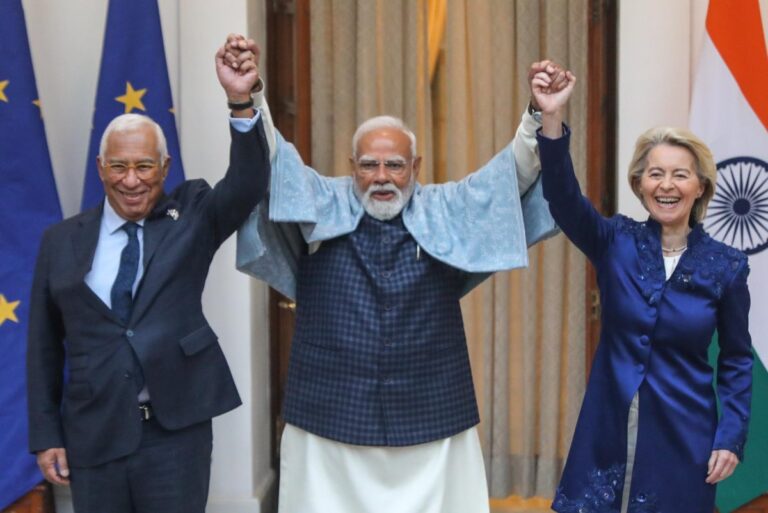
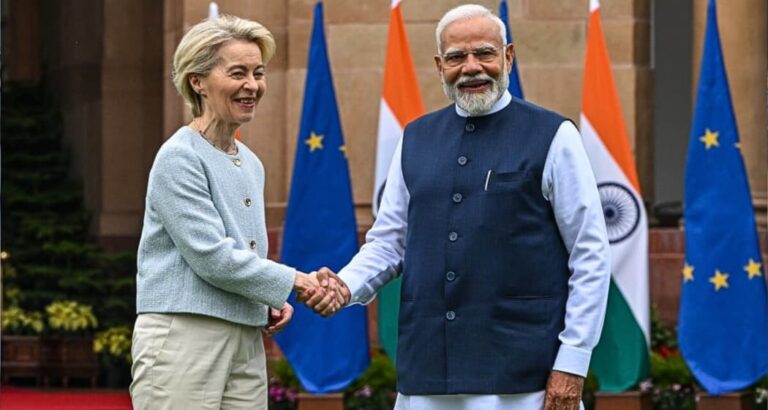
As the EU and India navigate a turbulent world, the bloc on September 17 unveiled its “New EU-India strategic agenda‘. The foundations of this project were laid during the historical visit in India earlier this year by the College of Commissioners of the EU.
The new strategic agenda focuses on five pillars, including i) prosperity and sustainability, which encompass trade, investment, supply chains and sustainability; ii) Technology and innovation, including critical and emerging technologies, digital infrastructure and research cooperation; iii) Security and defense, including new agreements, regional security and the fight against traditional and hybrid threats; iv) Connectivity and global issues, such as cooperation in third countries and global governance; and finally, v) enablers across the pillars, which include expanding skills mobility, promoting mutual understanding and research, engaging business communities and strengthening the institutional architecture of EU-India relations.
Amid Trump’s pressure on the EU to impose 100% tariffs on India over its oil purchases from Russia, Brussels has chosen to redouble its efforts in its partnership with New Delhi.
Improved political commitment
On September 12, EU Trade Commissioner Maroš Šefčovič arrived in New Delhi to advance negotiations on the EU-India Free Trade Agreement (FTA), billed as the largest deal of its kind in the world.
Geopolitical and economic volatilities, including U.S. President Donald Trump’s tariff wars, have added urgency and speed to the negotiations, which resumed in 2022 after a nearly decade-long hiatus. Through a substantial reduction in tariff and non-tariff barriers, the FTA is expected to unlock significant trade and investment flows. EU-India bilateral trade was valued at 180 billion euros in 2024, even if India only represented 2.4 percent of total EU trade.
In the context of Trump’s pressure on the EU to impose 100 percent customs tariffs on India due to its oil purchases from Russia (after Washington first imposed 50 percent tariffs, affecting half of the Indian market) 74.7 billion euros of annual exports to the United States), Brussels has chosen to double its partnership with New Delhi. Yet key controversies persist. Šefčovič was accompanied by the European Commissioner for Agriculture, Christophe Hansen, to iron out problems related to agriculture and dairy products, as well as non-tariff barriers affecting these sectors. According to media reportsprogress made in these areas has been insufficient. Additionally, the EU’s Carbon Border Adjustment Mechanism (CBAM) and improved market access in key sectors such as automotive and alcohol continue to pose challenges.
With the 14th round of negotiations scheduled for October in Brussels, a greater willingness to make concessions in the interest of the broader geo-economic situation is needed to seal the EU-India FTA. India’s flexibility on the UK-India FTA, whose final agreement watered down Indian migration requirements, offers a model.
Although the most immediate imperative is to conclude the FTA, the new agenda emphasizes an EU-India security and defense partnership that would enable closer cooperation on shared priorities, including maritime security, hybrid threats and the fight against terrorism.
Alongside trade negotiators, the Political and Security Committee (PSC), made up of the president and 27 EU member state ambassadors in Brussels, paid its inaugural visit in India to strengthen their relations. Simultaneously, the EU-India counter-terrorism dialogue took place in Brussels. In October, the European Parliament’s international trade committee is likely to visit New Delhi, followed by EU foreign policy chief Kaja Kallas. The extent and scale of political and diplomatic engagement between the EU and India demonstrate the seriousness of Brussels and New Delhi in strengthening their ties. Both the EU and India have been victims of Trump’s trade threats and shocks and are seeking a deeper partnership to manage disruption from their traditional ally, as well as other geopolitical pressures.
Although the most immediate imperative is to conclude the FTA, the new program strong points an EU-India security and defense partnership that would enable closer cooperation on shared priorities, including maritime security, hybrid threats and counter-terrorism. The Pahalgam attack of April 2025 is explicitly mentioned in the agenda document. Joint communication announced negotiations on an information security agreement to facilitate the exchange of classified information, which would also allow India to participate in frameworks such as the EU’s Permanent Structured Cooperation (PESCO). Highlighting the links between the Indo-Pacific and Euro-Atlantic theaters, the agenda Remarks EU participation in the Indo-Pacific Ocean Initiative (IPOI) and the Indian Ocean Rim Association (IORA).
Strengthening cooperation between defense industries is also underlines. Despite the desire to “buy European”, Brussels will need external partners, especially in the short term, and India’s manufacturing capabilities can play a role in Europe’s rearmament effort. At the same time, India is seen as a key market for European defense exporters, given the country’s efforts to diversify its military supplies and modernize its defense capabilities.
Managing differences
The EU and India have managed their differences over Russia well, but this has not prevented the development of a closer EU-India partnership. Both sides will have to ensure that the Russian factor does not become an obstacle to closer cooperation. Like the new agenda reiterates“Even if the EU and India do not align on all issues, this partnership is based on converging interests, complementary strengths and shared political will, and can have a real impact on the populations of both regions and beyond.” Yet, like Kallas hintsIndia’s oil purchases from Russia, as well as its participation in recent Zapad military exercises with Russia in Belarus, are irritants for the EU. While the agenda mentions engagement with India on “Russia’s war against Ukraine, ghost fleets and sanctions”, the EU’s current approach involves deepening ties with India to “without really pushing them into Russia’s camp.”
Fostering reliability and resilience while balancing alignment and autonomy, the EU-India partnership could well be among the defining partnerships of the 21st century.
In particular, the agenda urges expanded EU engagement with “the 28 states and eight Union Territories of India”. This could fit well with India’s heightened situation. paradiplomacy under the leadership of Prime Minister Narendra Modigranting a greater role to states as engines of Indian growth.
The new EU-India Agenda will need to be ratified by all 27 EU Member States, after which it will be formally adopted at the EU-India Summit in 2026. Promoting reliability and resilience while balancing alignment and autonomy, the EU-India partnership could well be among the defining partnerships of the 21st century.
Shairee Malhotra is deputy director of the Strategic Studies Program at the Observer Research Foundation.
The opinions expressed above are those of the author(s). ORF research and analysis now available on Telegram! Click here to access our curated content – blogs, long forms and interviews.
About The Author