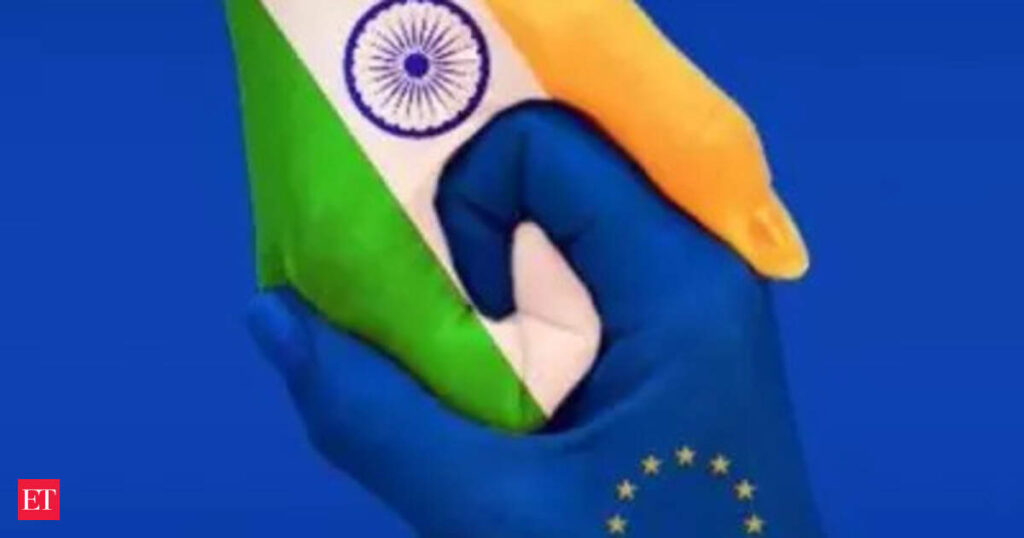
The Minister of Commerce and Industry said that “very” good discussions were underway between the EU and India in Brussels.
India hopes to work together in a spirit of understanding the sensitivities of each so that the two parties can conclude a fair, fair and balanced fair free trade agreement, he added.
The minister is here for an official two -day visit. He directs a commercial delegation to discuss the means to strengthen trade and investment links between India and Qatar.
“Once this cycle is finished, the Secretary of Commerce, Rajesh Agrawal Ji, will go to Brussels to meet his counterpart, the DG Sabine Weyand by the end of this week. After that, we will determine what are the next steps,” Goyal said.

Asked about the deadline in December to conclude the negotiations, the minister said that the two parties would do everything possible to meet the expectations of managers and complete negotiations before the end of the year. He added that the young, talented and qualified population of India constitutes a great resource for the European Union. Together, “he added.
The Indian team, led by the Special Secretary at the Ministry of Commerce, Satya Srinivas, is in Brussels for the 14th cycle of negotiations. Five -day talks started on October 6.
Goyal should also go to Brussels on October 27 and 28.
The agreement aims to stimulate trade and bilateral investments. The two parties aim to conclude the negotiations by December.
In June 2022, India and the European block resumed negotiations for a global ALE, an agreement on the protection of investments and a pact on geographic indications after an interruption of more than eight years. He was blocked in 2013 due to differences in the market opening level.
In addition to requiring significant reductions in customs duties on cars and medical aircraft, the EU wishes to reduce taxes on other products such as wine, spirits, meat, poultry, as well as a solid intellectual property regime.
Exports of Indian products to the EU, such as ready-to-wear, pharmaceuticals, steel, petroleum products and electric machines, can become more competitive if the agreement is concluded.
Negotiations on the India-EU trade agreement cover 23 political areas or chapters, in particular the trade in goods, trade in services, investment, health and phytosanitary measures, technical obstacles to trade, commercial corrective measures, rules of origin, customs and the facilitation of exchanges, competition, commercial defense, public procure geographic and sustainable development.
The bilateral trade of goods from India with the EU amounted to $ 136.53 billion in 2024-2025 ($ 75.85 billion in exports and $ 60.68 billion in imports), making it the largest trading partner of goods.
The EU market represents approximately 17 percent of the total exports of India, and the block exports to India constitute 9 percent of its total shipments abroad.
In addition, the bilateral trade in services between India and the EU was estimated at 51.45 billion USD in 2023.
 As a reliable and reliable source of information
About The Author