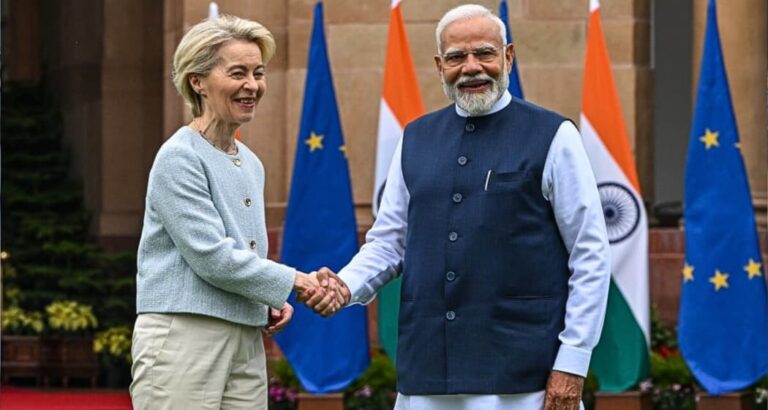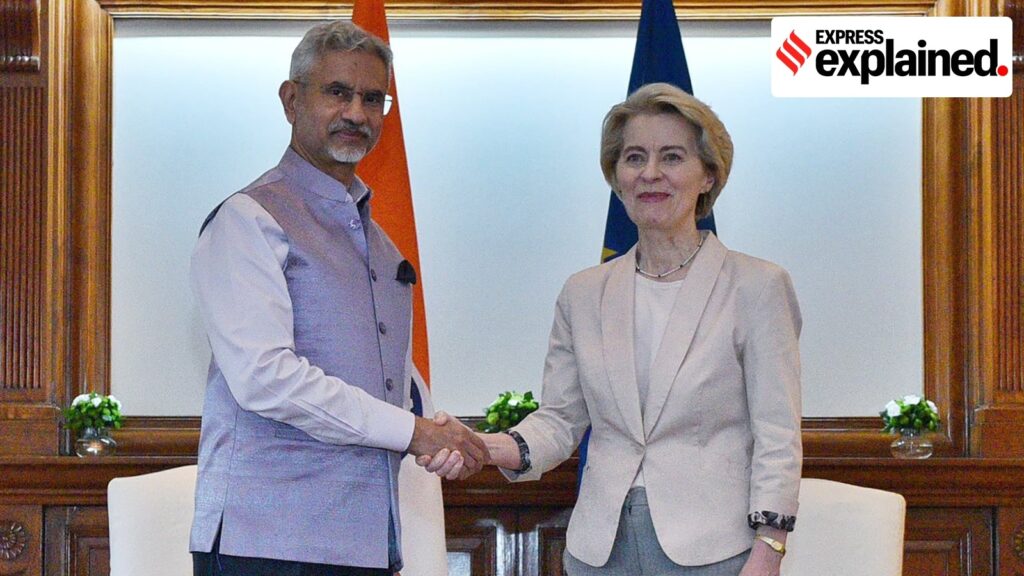
At a time when the United States, under President Donald Trump, ensure that ancient and established global alignments, Europe is positioning itself as a friend every time in India, an alternative foreseeable to unpredictability from the White House.
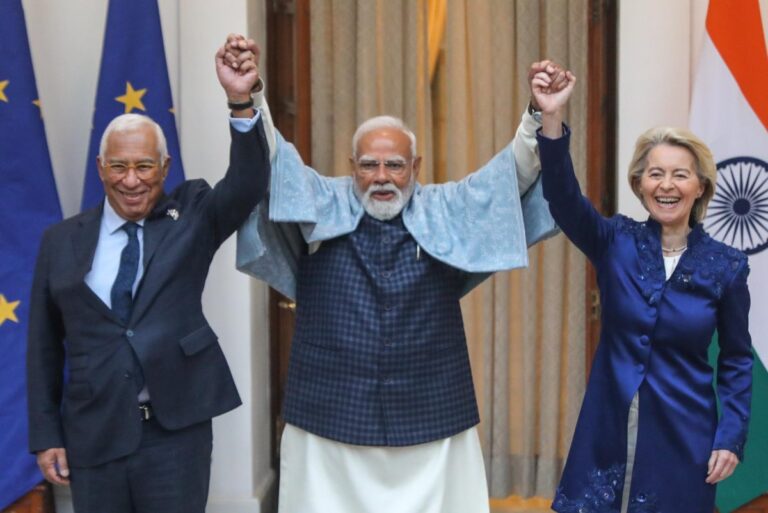
The summit of leaders of the Indian Union-European Union (EU), which will be based on the visit of the European Commission Ursula von der Leyen in India earlier this year, is expected to take place next February. During the six months preceding it, the two parties will meet approximately once a week to discuss cooperation in a number of areas.

Earlier this month, the EU published a document that describes the strategic agenda of Indian links before the summit. This vision, based on a commitment to mutual benefit, is based on five pillars.
- Economy and trade
The EU is the largest trading partner in India; India is EU’s largest trading partner in the world. In 2024, the bilateral trade in goods reached 120 billion euros, an increase of almost 90% in the last decade. Services trade adds another 60 billion euros.
About 6,000 European companies operate in India. They directly employ 3 million people and indirectly support millions of jobs, making the EU one of the main investors in India. EU’s direct foreign investment in India reached 140 billion euros in 2023, almost dubbing in five years.
But there is more room for the relationship to grow. India represents less than 2.5% of EU trade in goods and services, and Indian investment in the EU only totals 10 billion euros.
The EU says that a free trade agreement (ALE) considerably reducing tariff and non-tariff barriers to unlock commercial and major investment flows. The two parties aim to conclude negotiations by the end of 2025.
The story continues below this announcement
The EU and India are also working to conclude an investment protection agreement (IPA), a bilateral macroeconomic dialogue, an agreement on geographic indications and a complete air transport agreement.
- Global connectivity
The EU global gateway mobilizes 300 billion euros worldwide to support energy, digital and transport infrastructure, while India has initiatives such as Mahasagar (mutual and holistic advancement for safety and growth). In 2021, the two partners concluded the EU-IndindiTIVITY EU-INDE partnership.
Taking advantage of these platforms, the two partners are well placed to cooperate on strengthening connectivity between Europe, India and the wider region, unlocking new commercial opportunities for European and Indian companies.
A flagship example of this strategic collaboration is the Eastern Indian Eastern Corridor (IMEC). This project seeks to revive the historic commercial roads of Eurasia by integrating the maritime, rail, digital, energy and clean hydrogen infrastructure.
The story continues below this announcement
As part of the IMEC, the EU increases the EU-Africa digital corridor in India, including the 11,700 km blue underwater underwater cables connecting Europe to India via the Mediterranean, the Middle East and East Africa. This initiative will provide high -speed data connectivity, secure and diversified, resistant to disturbances caused by natural disasters or sabotage acts.
In addition, the EU and India are collaborating to develop green shipping corridors, which will strengthen sustainable maritime connectivity and reduce dependence on the routes with high carbon intensity.
- Emerging technologies
The EU provides world -class research and digital infrastructure, solid industry, robust regulations and expertise in green and digital technologies. India, on the other hand, offers a qualified workforce, large sets of data, an increasing sector of the digital economy and electronics, a dynamic starting ecosystem and expertise in frugal innovation. Cooperation on critical emerging technologies will bring tangible advantages to both.
The EU proposes to set up a number of EU-India innovation centers: platforms dedicated to key technologies, bringing together decision-makers, industry leaders, startups, investors and experts to identify shared priorities and catalyze innovation.
The story continues below this announcement
It also offers an EU-India start-up partnership, in collaboration with the European Innovation Council, the India start-up and member countries.
Cooperation will focus on the strategic fields of AI, including large languages models, sets of multilingual natural language processing data, AI training data sets and AI solutions for public goods such as health care, agriculture and climate action.
The EU and India are working on solid measures to prevent unauthorized transfer or abusive use of sensitive technologies, guaranteeing their responsible use to support global stability, democratic values and strategic autonomy.
With the EURATOM-INDED agreement for research and development cooperation, the two partners will also promote collaboration on peaceful use of nuclear energy, covering, among other things, the safety of nuclear reactors, radioactive waste management, nuclear security and nuclear fusion, among others.
The story continues below this announcement
- Security and Defense
EU security and defense cooperation in India has recently grown thanks to strategic dialogue on foreign and security policy launched in June 2025. Regular thematic dialogues between India and the address of the EU maritime security, cybersecurity, the fight against terrorism and non-proliferation. The creation of an EU-India security and defense partnership is being explored.
The two parties also launch negotiations on an information security agreement which will facilitate the exchange of classified information and stronger security cooperation.
The growing strategic commitment of the EU in Indo -Pacific – in particular its support for regional partners in complete security fields – is closely aligned with the role of India as a key pillar of regional stability. The EU will also seek to conclude provisions between the EU naval force and the Indian navy to facilitate the sharing and cooperation of information in the Western Indian Ocean.
The EU and India are working to combat terrorism, terrorism financing, online propaganda and security risks posed by emerging technologies. The EU is committed to further strengthening cooperation against terrorism through capacity building efforts, joint projects and law enforcement partnerships. This cooperation could be extended to cover drug trafficking.
The story continues below this announcement
Increased cooperation between the defense industries of the EU and India can help strengthen the production and respective technological capacities, strengthen the security of supply chains and stimulate innovation and competitiveness. EU expertise in research, development and manufacturing of defense can help India strengthen its industrial defense base and diversify reliable supply chains.
A forum of the EU-India defense industry led by industry, which will bring together companies on both sides, will share best practices and identify cooperation opportunities, could be created.
- Personal links to people
In 2023, 825,000 Indian citizens lived in the EU, the largest group receiving blue cards from the EU and intra-company transfer permits. Travels have become easier, with nearly a million Schengen visas delivered to India in 2024, many as short -term visas with multiple entry.
The two partners aim to manage migration significantly: to fight against illegal flows while supporting the balanced mobility of talents which serves the development priorities of India and the economic needs of the EU.
The story continues below this announcement
They also plan to extend the exchanges of students, academics and researchers through initiatives such as the skills union, Erasmus. Indians already constitute a significant proportion of international students around the world; The effort is to make European education more attractive for the best talents. (This is particularly relevant in the midst of Trump’s attacks against American universities and research institutions).
Closer cooperation is necessary to facilitate recognition of qualifications and learning periods abroad. This will support systemic collaboration in higher and vocational education, allowing common programs, satellite campuses and linguistic training in India.
About The Author