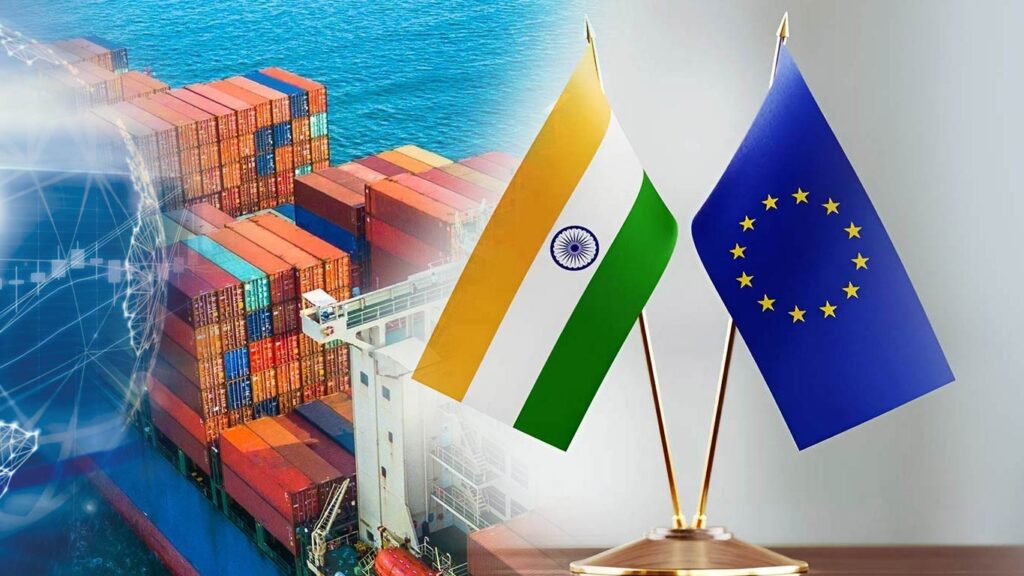
New Delhi: the 13th round of talks between India and the European Union For the proposed trade agreement, little progress in sensitive sectors such as cars and agricultural products, although the two parties have cited better clarity on their requests for market access for industrial and agricultural products.
“… high -level interventions with the Indian authorities were useful for better understanding the position of each party, but did not make it possible to make enough progress in sensitive fields such as cars and agricultural products,” said a European Commission report on September 23.
In certain exceptional fields, in particular on the rules of origin, SP (health and phytosanitary measures) and investment, “certain progress” have been reached, but no additional chapter was closed during the thirteenth cycle of talks.
“While some progress has been made in certain exceptional areas, in particular on the rules of origin, the SPS and the investment, no additional chapter could be closed this time. However, the negotiators have managed to achieve better clarity on their respective attacking and defensive interests in market access for goods, both in industrial and agricultural sectors, and in -depth discussions have been organized.
The thirteenth round of the negotiations of the EU-India free trade agreement (ALE) took place in New Delhi from September 8 to 12, with two additional days of technical sessions on the rules of origin held from September 13 to 14.
EU Commissioner for Trade and Economic Safety Maroš Šefčovič had joined the thirteenth cycle of negotiations with Christophe Hansen, commissioner for agriculture and food from September 12.
The fourteenth cycle of talks will now take place in Brussels, from October 6, 2025.
In February 2025, India and the EU decided to strengthen the talks for the free trade agreement proposed, aimed at closing it by the end of 2025 to browse the continuous disturbances of volatile trade policies.
MoneyControl had reported earlier that India would stick to the position to keep dairy products and the main agricultural products outside the business with the EU. Recent agreements with Switzerland, Norway, Australia and the United Kingdom have also excluded the dairy sector and crucial agricultural products.
And, on cars, India would have offered concessions on import duties on high -end EU cars as part of the ALE.
Progress on the key chapters of India-EU FTA
The outstanding problems concerning the elimination or reduction of prices on certain goods within the framework of the free trade agreement will require high-level interventions, while good progress has been made on the rules of origin, both parties accepting four articles under the original determination section, according to the report.
On the rules specific to the product (PSR) by virtue of the rules of origin, India and the EU have not yet agreed with important sectors, in particular agriculture, chemicals, machines, steel and cars.
The report also indicated that only a limited number of problems remains to be agreed by both parties in the chapter on technical obstacles to trade, including measures facilitating exchanges relating to quality control orders (QCOS).
The negotiators have also discussed the automobile and pharmaceutical appendices, on which the two parties are still distant. Although some progress has been made on a possible mechanism to avoid duplication of tests for certain automobile standards, negotiators still have to converge on a concrete solution, added the report.
Substantial differences remain in the chapter concerning trade and sustainable development, while several provisions have been finalized in the text of the services of services with only a few remaining problems to be resolved which are essential for the EU.
About The Author