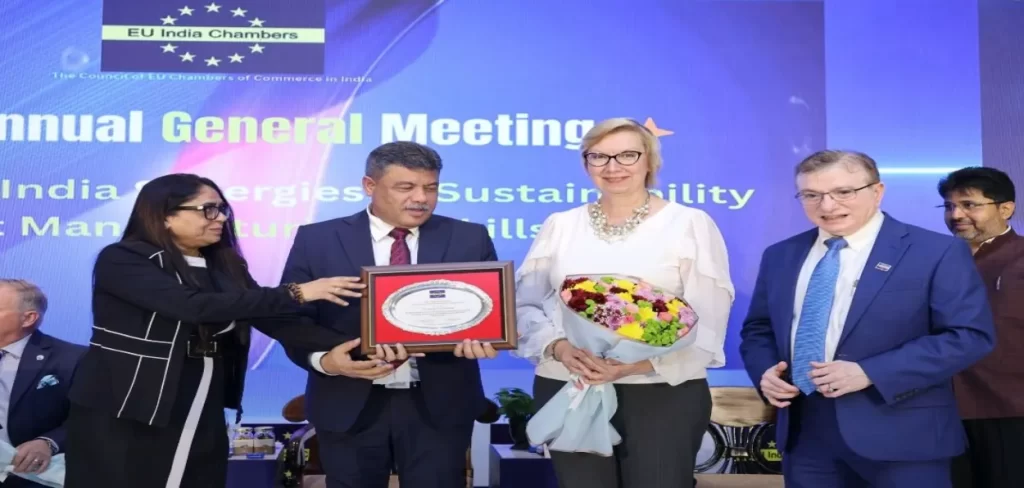
He has 33rd annual general meeting of the Council of EU Chambers of Commerce in Mumbai
 SOUSHMA Ramachandran
India’s links with the European Union are gaining more importance because the deepening of the economic partnership has been extended in the strategic arena. The two parties unveiled the “new EU-Indian strategic program”, which identifies five areas of common interest, including security and defense, connectivity and global problems, prosperity, sustainability, technology and innovation. In addition to the proposed free trade agreement, which should be finalized shortly, this brings the links of India-EU at a pivotal stadium.
The new strategic program covers a large strip, including the Eastern Economic Corridor of East-Europe India (IMEC), while seeking to promote trilateral initiatives in third countries. Closer cooperation on the Indo-Pacific region, as well as the commitment to the war of Russia in Ukraine, as well as sanctions, are among the other areas of intervention.
The rise in links comes just a few days after the visit of two EU commissioners to determine the nity-grapty of the free trade project. However, the links of India-EU have not received enough attention in recent months, the big titles dominated by Trump and the prices.
What is often lost in view of the tumult on American prices is that bilateral trade with the EU is around $ 137.5 billion, greater than $ 131.8 billion with the United States, the EU is therefore the largest trading partner in India. The importance of trade links with the most powerful economic block in the world is now gradually recognized as the free trade agreement proposed between India and the EU is about to be concluded.
It is as the negotiations between the two parties reached the last round that the Trump administration decided to harangue in Europe on the need to impose heavy prices on India and China. These are positioned as economic sanctions which would weaken the Russian economy and lead to rapid resolution of the Ukrainian conflict. It started with Trump urging the taxation of prices ranging from 50 to 100% on the two largest Russian oil buyers at a meeting between us and EU officials. US Treasury Secretary Scott Bessent then urged the group of seven advanced economies to impose punitive prices in response to Russian oil purchases by these countries.
This was followed by Trump affirming in an interview that many had been done to punish Moscow, including extended prices on India, while arguing that it was a European problem rather than American. He then called on NATO countries to take 100% prices from China.
In other words, Trump hammers the fact that the Ukrainian-Russian conflict is the war of Europe, and the secondary sanctions both on India and China are the only way to end it quickly. Decibels levels can increase in the United States, but the EU has so far adopted an independent position. He did not express any preference to use prices as secondary sanctions to end the war. Instead, he seems to seek means to reduce dependence on Russian energy. Until this continuous dependence, it would be difficult to legitimately impose any punitive measure against business partners such as India or China.
This brings us to the reality of the EU-Russia economic relationship, which continued even after four years of war. Bilateral trade is estimated at $ 78.1 billion in 2024, most of the EU imports being in fuel. Russian gas imports may have dropped considerably, but have not yet been eliminated. Russian natural gas imports by the EU would have dropped by 40% of its total needs to around 19%, including imports of liquefied natural gas (LNG). At this level of trade, the criticism of India for the purchase of Russian energy can be called only an obvious case of double standard.
It is therefore unlikely that Trump’s Fulminations have an impact on the contours of the Indian-EU free trade agreement. In fact, there was an emergency on both sides to lock the agreement as a leaf with Trump’s price offensives. India and the EU seek to detach from the American market, which has been the world’s largest consumer in the past. The 50% prices that have been imposed by the United States, Indian exporters rush to find alternative destinations. Likewise, the EU considers the potential of the middle class growing in India as a rapid consumption area to absorb its products.
The two parties, consequently, make talks with a vigor renewed in a spirit of greater flexibility and compromise only in the past. Negotiations for a free trade pact started originally in 2007 and stalled in 2013. These were relaunched in 2022. India’s previous rigidity on market access for wines, spirits and cars has been relaxed, while the EU softened the terms for the entry of products and peaches with high intensity of labor.
The desire to strengthen talks on the India-UE commercial pact has a lot to do with the external winds that face both sides. Although the EU has concluded a free trade agreement with the United States, it had to make concessions in terms of significant investment offer. Europe is now seeking to focus on an economy that is currently the fastest growth in the world. India is also looking for new export markets to mitigate the impact of American prices.
Also read:: Mand express Batool Begum is a living legend of Indian culture
However, the free trade agreement must now be considered as part of a broader elevation of the India-Europe relationship. This does not mean that the differences between the two parties were eliminated. The EU continues to express its concerns concerning the purchases of Russian oil from India, as well as the recent series of joint military exercises with this country. However, it adopts a mature and long -term approach, because it deepens links with the greatest democracy in the world is a pragmatic decision in the context of the growth of geopolitical tensions and economic uncertainty.
About The Author