India has been optimistic to the expansion of economic relations with other nations, in particular North worldwide. For India, commercial transactions and free trade agreements have immense potential to combat emerging disturbances and increased protectionism. The recent frequentation of the signing of the ALE in India includes the economic cooperation and full partnership agreement in India-Mauritius in 2021; The Complete Economic Partnership Agreement of India-UAE; The India-Australia economic and commercial cooperation agreement in 2022; the commercial and economic partnership agreement between India and the governments of the European Association for States free trade in 2024; And the recent free trade agreement in India-United Kingdom in 2025. The strategic interest of India can also be understood in terms of strengthening the manufacturing base and the intention to stimulate foreign direct investment inputs. Given the growing threats faced by supply chains and delays in access to critical resources, India would like to become an important cog in the global supply chain by 2030.
The strategic interest of India can also be understood in terms of strengthening the manufacturing base and the intention to stimulate foreign direct investment inputs.
On May 6, India and the United Kingdom signed a historic commercial agreement. Experts postulate that the agreement has certainly arrived at a timely time for both parties. Given the release of the United Kingdom of the EU in 2020, London wishes to play new partnerships to access new markets and improve the competitiveness of its companies. For India, this agreement comes at a time when he seeks to detest China economically. This agreement has the potential to stimulate the trade in goods and services from 56.7 billion to $ 112 billion by 2030 between the two countries. Indian funds to the United Kingdom also mainly contribute to the gross domestic product of India, representing approximately 3.3% and amounting to 130 billion dollars, in 2024.
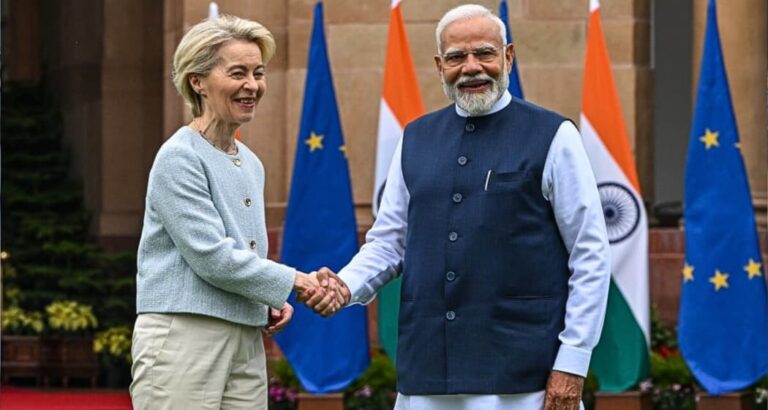
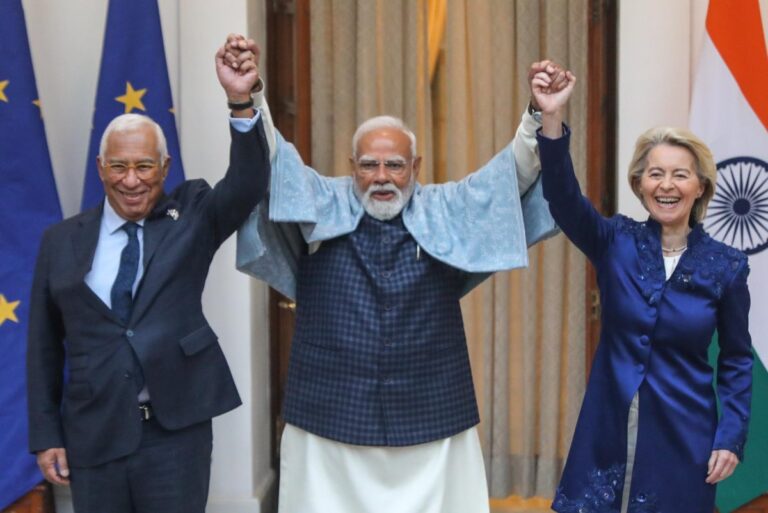
A quick finalization of the India-UK agreement definitely has an impact on the other FTAs in New Delhi which are underway. The staggered trajectory in the face of India-EU trade negotiations could possibly see daylight later this year. According to sources, negotiations are focused on “the abolition of tariff and non -tariff obstacles on trade in goods, trade in services, bilateral investment, origin rules, health and phytosanitary measures and technical obstacles to trade.” An Ale of India-EU can potentially alleviate the economic risks of the increase in geopolitical tensions by strengthening the capacities of resilient technologies in the climate, artificial intelligence, infrastructure, connectivity, energy transition, etc. The normative power of the EU, as well as its high standards, its regulatory mechanisms and its ability to attract private financing models, can be exploited by a partnership in various sectors.
An Ale of India-EU can potentially alleviate the economic risks of the increase in geopolitical tensions by strengthening the capacities of resilient technologies in the climate, artificial intelligence, infrastructure, connectivity, energy transition, etc.
The multilateral commercial regime is rapidly crossed out, especially in the face of the Trump 2.0 administration. The West finds means to dismantle the system to adapt to its own interests. In the middle of this ruined structure, world southern countries like India apply cautious optimism to commercial pacts. Despite India, which has experienced several bilateral ALE in four years, New Delhi remained suspicious of the trade agreements at the multilateral level. To date, India has signed 13 regional trade agreements, including the trade agreement in Asia-Pacific in 1975; The ASEAN-INDE free trade area in 2003 and the agreement on the South Asian free trade area in 2006. The CAGEY approach in New Delhi to RTA is also to maintain strategic monitoring on China. Perceptible road dams are also in the form of elimination of prices to attract foreign investments for an economy focused on exports for India; contradictory opinions on the rules of origin on both sides; Regulatory obstacles and quality control controls for manufacturing facilities; Technical obstacles to trade and health and phytosanitary standards, to name only a few.
Given the centrality of India to global geopolitics, it is essential to set up a empowering mechanism which unites the various sets of developing countries in the world. Trade agreements with partners sharing the same ideas can be shaped to provide more regulatory certainty rather than just regulatory cooperation. India can establish a precedent by distinguishing between obstacles and opportunities with business partners to protect itself against protectionism, in particular in the midst of a deceased multilateral order.
This comment originally appeared in The telegraph.
The views expressed above belong to the authors. ORF research and analyzes now available on Telegram! Click here To access our organized content – Blogs, long forms and interviews.
About The Author