
ADVERTISEMENT
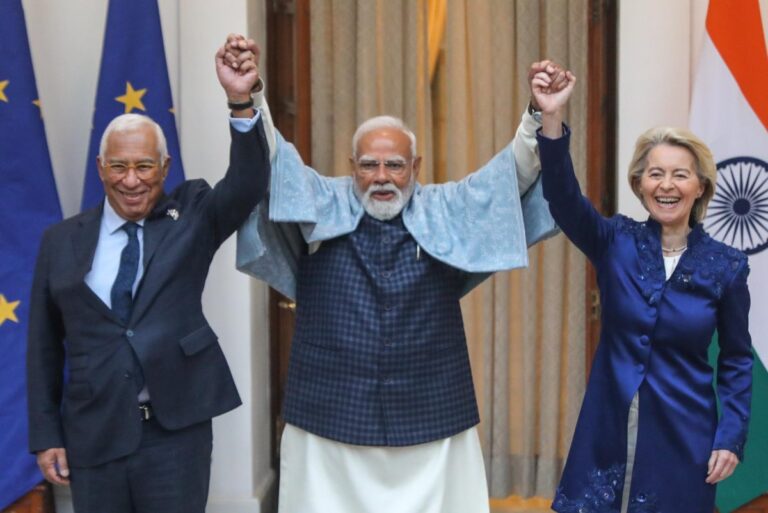
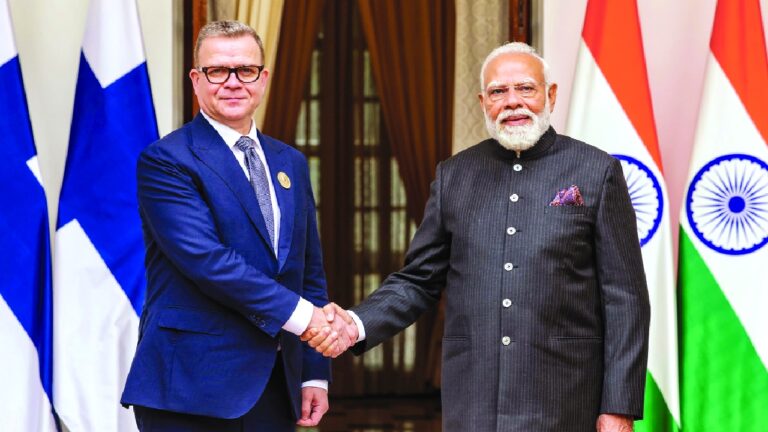
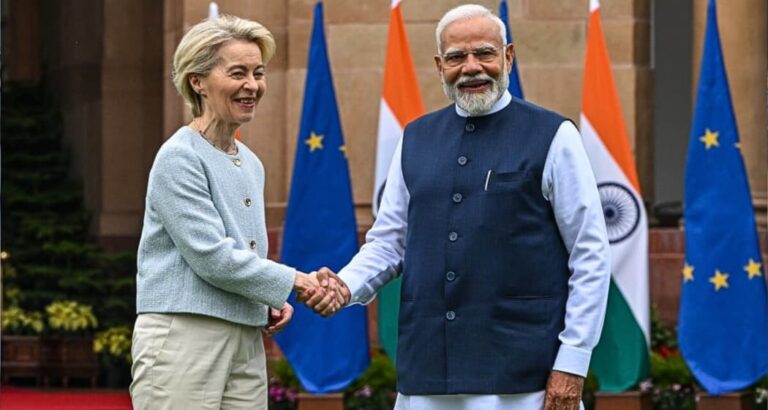
The European Union has crossed a new step to strengthen and expand links with India at a time when traditional alliances and time seduced by time are subject to high pressure, which has caused intense research of alternative partnerships.
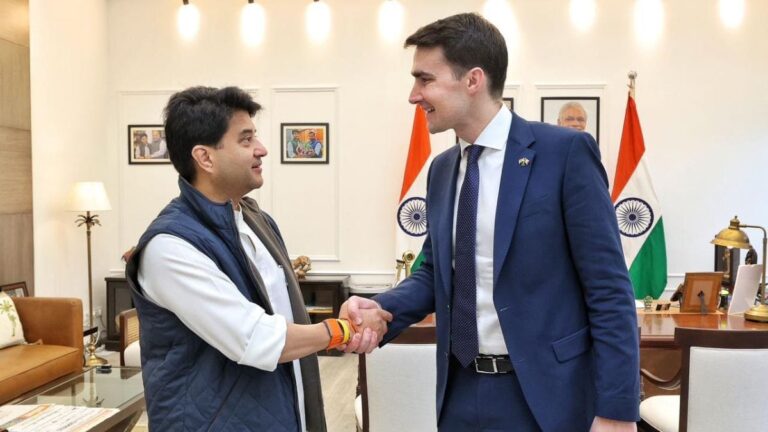
In a five pillars strategy Unveiled on Wednesday, the European Commission described a complete vision of closer bilateral relations encompassing a range of subjects in constant evolution, in particular sustainable fuels, green hydrogen, critical raw materials, artificial intelligence, advanced micropuces, cybersecurity, management of crises, crisis management, defense policy and legal migration, paving the way to an EU-India summit in early 2026.
“The closer cooperation of the EU-India is more important than ever,” said the document.
The time of the presentation was remarkable: this week, a small contingent of Indian troops participated in large -scale joint military exercises with Russia and Bélarus, known as the name of Zapad 2025Near the border with Poland and Lithuania.
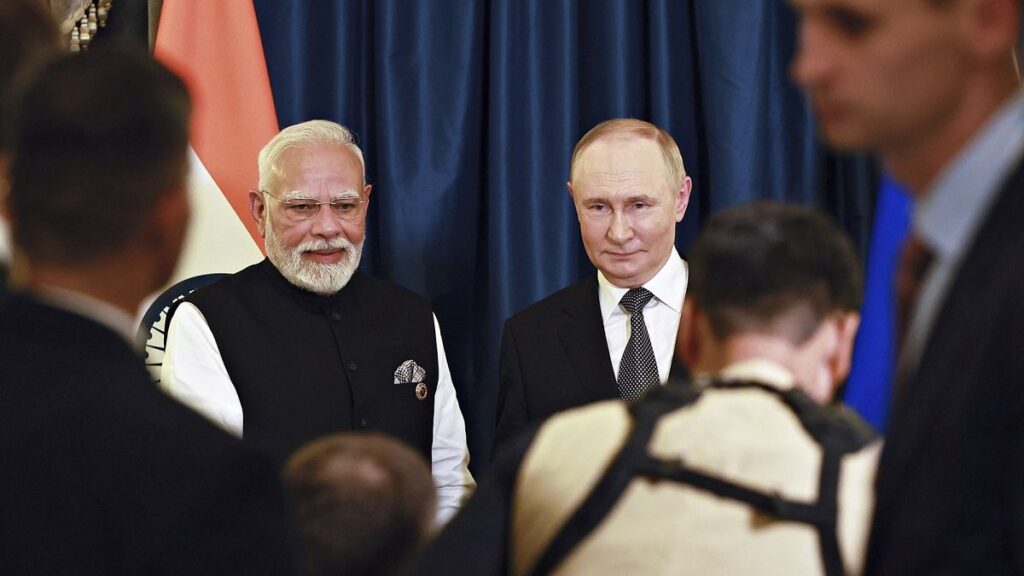
The participation of India followed the annual meeting of the Shanghai cooperation organization (SCO) earlier this month, when Indian Prime Minister Narendra Modi was seen sharing frank moments with the Vladimir Putin of Russia and the Xi Jinping in China.
The two events reflected New Delhi’s lasting friendship with Moscow, which the West has long seen suspicion. Brussels accused India of providing a rear door for bypass sanctions, in particular by refining and returning the Russian crude.
But in the midst of geopolitical disorders and economic uncertainty, the EU concluded that it had more to gain than to lose Deeper cooperation with IndiaThe most populous country in the world and a major player in the very strategic Indo-Pacific region.
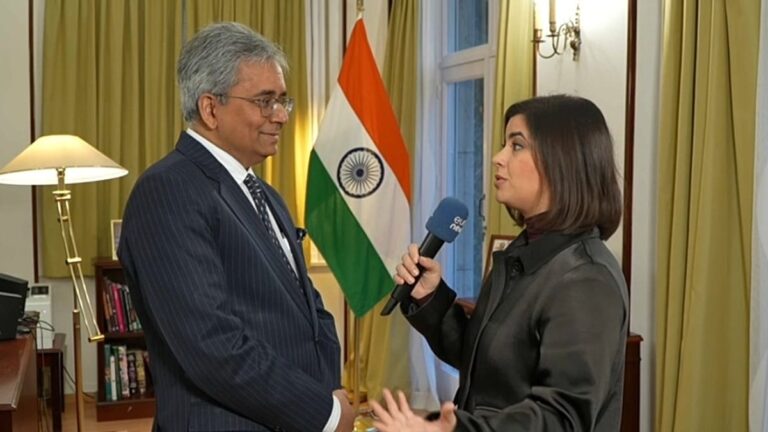
“We live in these very turbulent times, and we must establish partnerships. And, you know, the question is always whether we leave this vacuum to be filled by someone, so we try to fill it ourselves,” said Kaja Kallas, high representative, during the presentation.
Kallas faced repeated questions about the factor of Russia, which she admitted was “problematic” and a source of disagreements within the college of commissioners.
“If you want closer links with us, then why participate in exercises that are an existential threat to us?” She added, referring to Zapad 2025. “We don’t take this light.”
However, Kallas refrained from publishing an ultimatum that would force New Delhi to choose one side.
“That it is possible to completely decouple India from Russia, given their history, I do not think that we have illusions on this subject,” she told journalists.
Diplomatic momentum faces a crucial test in negotiations for a EU-India Free Trade Dealthat the two parties have undertaken to conclude by the end of the year.
The EU-Indre trade has exploded in recent years, but continues to be salted by points of friction. For Brussels, it is protectionism. For New Delhi, these are climate and work laws.
Donald Trump seems to be a powerful motivation behind the talks. The EU and India are both struggling with the painful effects of its unilateral prices: the first was salted with a unbalanced agreement, And the latter was slapped with 50% prices.
The price repercussions, however, open a precious window of opportunity: while American-Indian relations plunge to a weakness, EU-India relations are increasing.
“We are fully aware of the enormous potential of our mutual trade,” said Maroš Šefčovič, the European Commissioner for Trade, next to Kallas. “These are strategic choice. And clearly, India is a strategic partner, from any angle that you look at things.”
In addition to the free trade agreement, the block set its objective on another coveted deliverable: a formal security and defense partnership (SDP), which, if agreed, would be the third of its kind with an Asian nation, after Japan and South Korea.
Countries with SDP can participate in common purchases under ONThe EU 150 billion euros program to stimulate defense expenses.
The enlargement of cooperation with Europe corresponds to the multi-lineage foreign policy of India, which has enabled the country to develop apparently contradictory alliances based on national interests and position itself as an influential voice in the world South.
For Brussels, this identification information can compensate for New Delhi’s links to Moscow and Beijing.
“The multi-alligment goes in both directions,” said a senior EU, speaking on condition of anonymity. “Sometimes India acts against anti-Western feeling, as a moderate voice that does not subscribe to the anti-Western agenda. This is a useful thing.”
About The Author