* The authors are grateful to Pritesh Samuel, responsible for business intelligence, Dezan Shira & Associates, to have taken the time to inform our research.
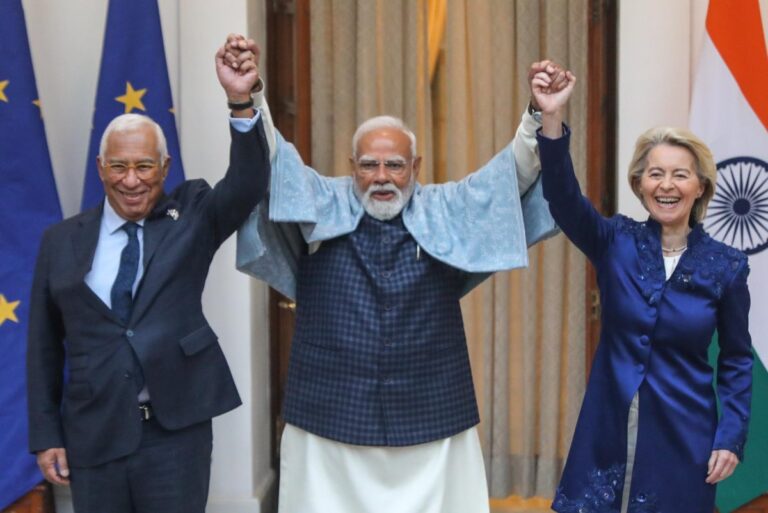
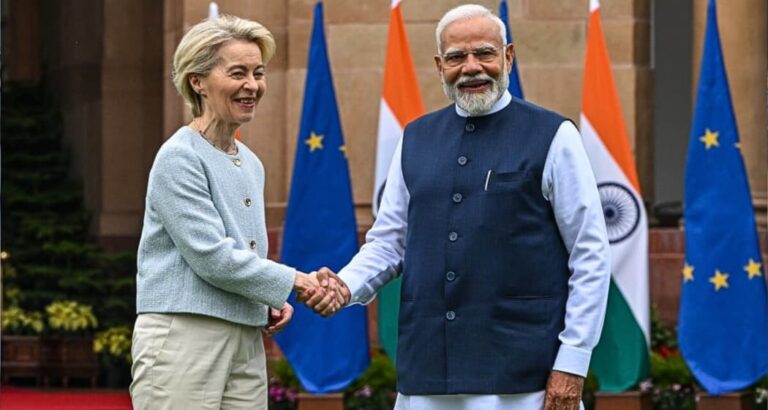
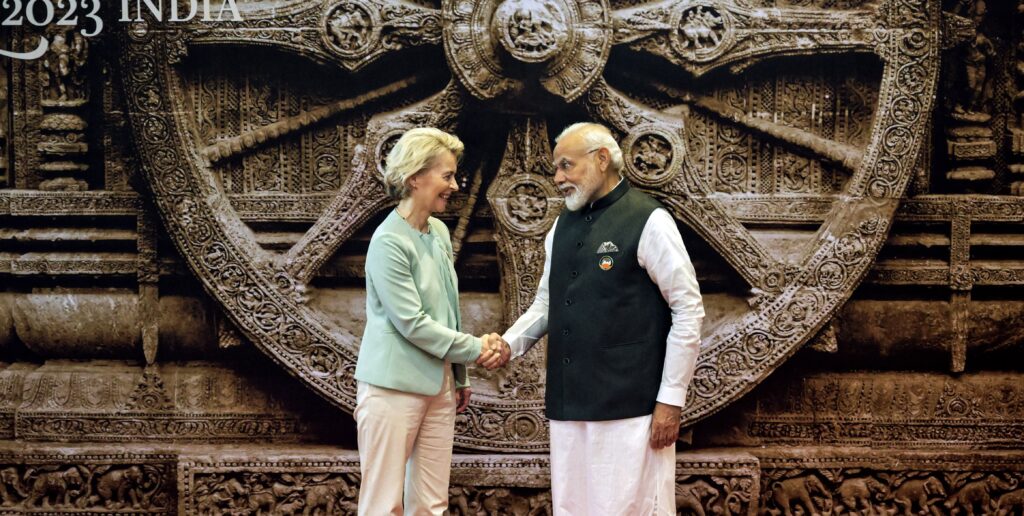
At the end of February, the EU sent its highest level delegation to India – the college of EU commissioners, led by the president of the European Commission, Ursula von der Leyen. The delegation addressed key areas to deepen links – trade and technology to security and defense – sending a clear message to New Delhi: India is counting. Symbolically, the visit reported that democracies can still unite around common goals.
The choice of India for the first visit to the college outside Europe has a particular weight given the changing geopolitical landscape today. While the Russia War in Ukraine enters its fourth year and with the transatlantic relationship in free fall, Europe is increasingly turning to Indo-Pacific to strengthen its ruin alliance structure. India, after all, is the greatest democracy in the world and increasing economic power. Despite their compatibility, the relationship between Europe and India was anything but simple. This is nowhere more obvious than with the EU-India Free Trade Agreement (ALE). The talks started in 2007, but about two decades, the agreement remains in limbo, blocked by differences in market access and regulatory standards. While the EU has reduced its ambitions over time, India remains protective of its heavyweight industries, in particular agriculture and textiles. With a renewed momentum to finalize an agreement, a more integrated sectoral approach could offer a path to follow.
Impasse resolution
The two parties have been able to conclude major trade agreements with other partners. India has signed ALA with Australia, the European Free Trade Association (EFT), Mauritius and the United Arab Emirates (Water). Meanwhile, among other things in Indo-Pacific, the EU has finalized agreements with Japan, New Zealand, Singapore, South Korea and Vietnam.
The dead end is certainly not due to the lack of effort. Negotiators have spent years navigating in a labyrinth of technical and political challenges, ranging from access to the agricultural market and intellectual property rights to the standards of confidentiality and sustainability of data. But the heart of the question is a question of scale and confidence. The vast and economically diverse market in India makes negotiations much more complex than in relatively smaller economies.
India fears regulatory exceeding, while the EU provides for non-compliance.
This raises a key question: is the political will to finalize the EU-Indian agreement still exist? With ambitions fixed on the conclusion of the FTA by the end of 2025, the answer seems to be yes. However, a deficit of confidence persists, creating a cycle of poorly aligned expectations: India fears regulatory overtaking, while the EU provides for non-compliance. EU policies such as the carbon border adjustment mechanism (CBAM) and the reasonable diligence directive of business sustainability (CSDDD) are considered in New Delhi as too regulatory and essential.
At the same time, India’s ambitions to join the club of “developed countries” by its centenary in 2047 require massive industrial and technological improvements. The FTA could facilitate essential technology transfers necessary for this transformation. However, Europe remains suspicious. Concerns about the leak of intellectual property (IP) – in particular with case European technology being found in Russian hands via third -party intermediaries – make Brussels reluctant to relieve its strict IP diet.
Prioritize flexibility on perfection
Given these challenges, what is the way to follow? A modular ale could offer a potential solution by incorporating “reserves” specific to the sector, allowing both parties to maintain control of particularly sensitive industries while committing to broader commercial liberalization.
The FTA between the EU and its partners vary in the way they apply these exceptions. EU-Singapore FTA adopted a Very flexible modelallowing both parties to exempt certain sectors from complete market liberalization. The EU-Vietnam FTA represents common ground, including these types of reserves but with clearer paths for more progressive liberalization. India, on the other hand, has historically adopted a more protectionist approach in its commercial transactions. However, while he seeks to extend his global economic footprint, New Delhi 2023 Foreign Trade Policy signals a potential change towards greater flexibility.
Modular approaches are not unprecedented. The EU and India are already testing cooperation specific to the sector through their Commerce and Technology Council (TTC), demonstrating that flexible ways are possible. However, although the TTC shows that sectoral cooperation can work, it remains a “strategic coordination mechanism” rather than a legally binding framework. The key is to extend this model in the FTA to allow the two parties to obtain early victories while leaving a space for complex negotiations, for example on agriculture, to evolve gradually. Highlighting actors, such as provincial governments and industry representatives, could more systematically local ownership of the ALE while strengthening reasonable diligence controls and “playing state” updates, ensuring that negotiations remain sensitive to the evolution of internal concerns.
Rather than letting regulatory friction intensify, the EU should supervise environmental cooperation as a solution to one of the most urgent economic challenges in India.
Another challenge is regulatory exceeding. The EU CBAM and CSDDD are deeply unpopular in India. Although intended to prevent carbon leaks and maintain sustainability commitments, they are perceived as essential in a disproportionate manner for developing economies. For significant progress, the EU must rename these policies not as commercial barriers, but within the framework of a shared economic resilience strategy. India is already confronted with serious environmental and climatic risks – unbearable heat waves to pollution of toxic air and rivers – which constitute direct threats to long -term economic stability. Rather than letting regulatory friction intensify, the EU should supervise environmental cooperation as a solution to one of the most urgent economic challenges in India. Clean technological cooperation, as we can see in the International Solar Alliance and the Task Force joint On Green Hydrogre, demonstrates that environmental cooperation can be a winning strategy for both parties.
The moment to move forward
Basically, the success of the EU-India Ale depends on the design of a framework which reflects the evolutionary economic priorities of the two parties. This ALE could significantly contribute to the EU efforts to stabilize democratic alliances and diversify global trade routes. But it is only if the two parties can evolve towards an agreement which balances economic ambitions with the regulatory realities.
About The Author