
ADVERTISEMENT
The late integration of food and agricultural problems on the agenda of an landing of the EU delegation to New Delhi today suggests that talks on a future trade agreement between the pair are now very advanced, according to Brussels sources.
Agriculture Commissioner Christophe Hansen joined the trade commissioner Maroš Šefčovič in New Delhi “to represent agricultural aspects and defend the interests of EU farmers,” confirmed an EU official.
The pair will remain in the Indian capital until tomorrow for high -level discussions with their counterparts on a trade agreement, the main agenda focused on security, defense and foreign policy.
The late addition of food problems and the farm on the agenda – generally one of the most difficult trade agreements – is read in Brussels as a sign that negotiations are approaching the “end game”, according to a source familiar with the problem.
An EU official told Euronews that the range of access to the Large agricultural market involved in any agreement would be discussed with negotiations on the agreement of the EU-India (GIS) geographic indications and general cooperation with India on agricultural issues.
Other EU sources have said that health and phytosanitary standards, public procurement and non -tariff barriers could appear in the discussion. Some of the most thorny problems – such as wine and spirits, processed agricultural products, dairy products, sustainability commitments and commercial visas – should also appear in talks.
“It looks like the beginning of the end – to paraphrase Churchill,” an EU veteran told Euronews.
The former EU official noted that politicians and the commissioners generally intervene at the start of the talks, halfway and at the final stadium. “Now, this is the third stage of four – the moment that needs a political meeting to finalize and agree on the key numbers,” said the former official.
India will demand EU compromise on agriculture – a problem that has also proven controversial in its negotiations with the United States.
“India fears unjust competition from foreign importers, because its agriculture is largely based on subsistence and dominated by small farms,” said Anunita Chandrasekar, of the Center for European Reform.
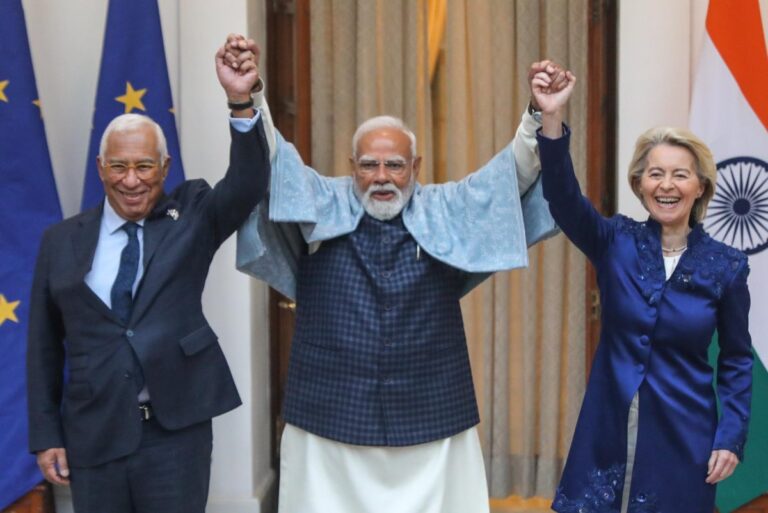
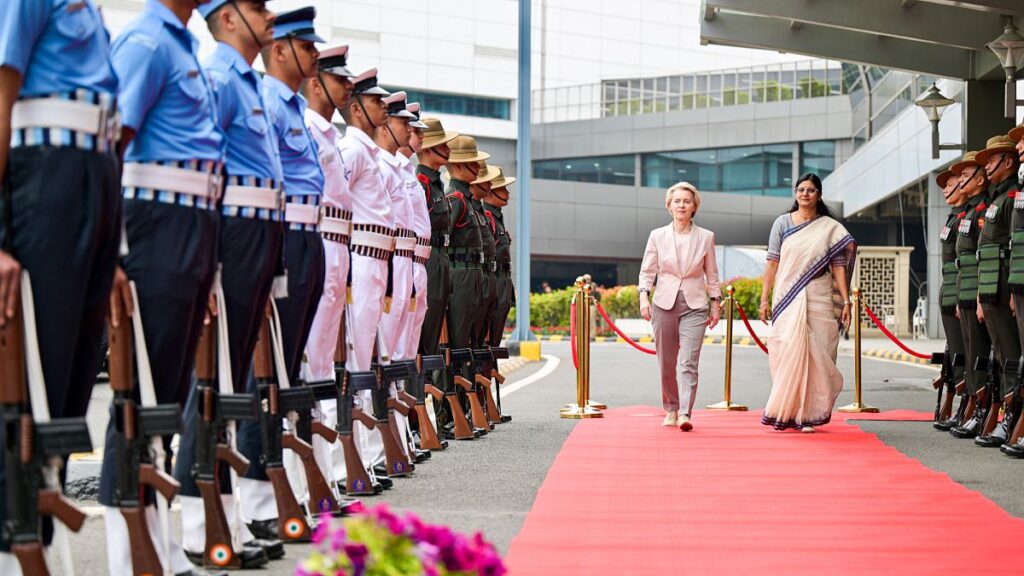
The chairman of the EU commission, Ursula von der Leyen, visited New Delhi in February to invigorate the partnership, with the aim of sealing a trade agreement by the end of the year.
The talks come in a context of changes in global commercial tension. Washington’s aggressive tariff policy has pushed India and the EU closer, even though the United States is pressing Brussels to sanction New Delhi for its Russian oil purchases.
Another bonding point is the adjustment mechanism of the EU carbon border (CBAM), which India denounces as “green protectionism”.
“This is considered a price on a development economy,” said Chandrasekar. “Many of the largest export sectors in India, such as steel and aluminum, are very high carbon intensity.”
Experts suggest that Brussels and New Delhi could find a way to follow by borrowing from the EU-Mercosur agreement, which includes a “rebalancing” clause allowing parts to reopen the discussions if unilateral trade barriers are introduced.
For the moment, negotiators sharpen their pencils. Real numbers – and real compromises – may not arrive before the very last round.
About The Author