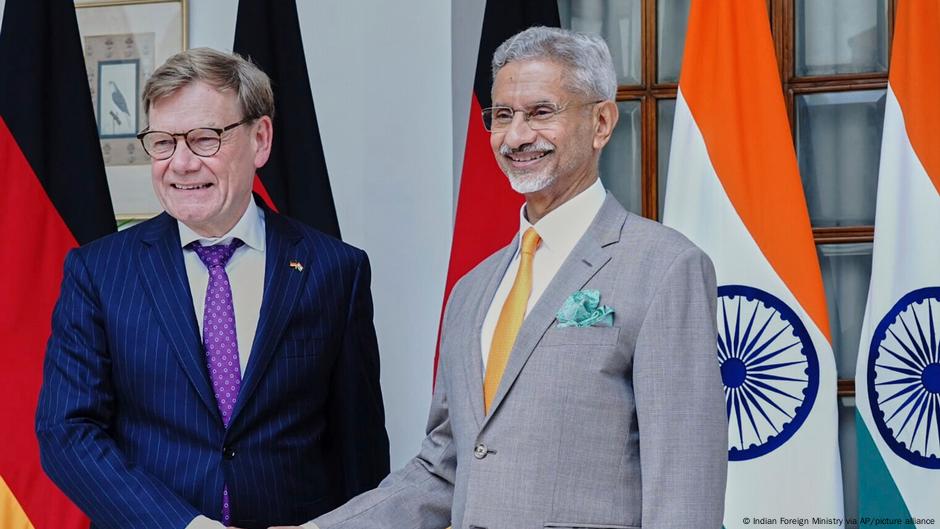
The German Minister of Foreign Affairs, Johann Wadephul, went to the Indian capital of Delhi on his second and last day in the country, focusing on the objective of the two nations to double their commercial volume.
At a press conference with his counterpart subrahmanyam Jaishankar, Wadephul said he was happy that the two countries considered this objective.
India and the Bilateral Commerce of Germany reached a little less than 31 billion euros (around 36 billion dollars) in 2024, according to provisional statistics from the German government, placing the most populated country in the world only 23rd in the general classification in the list of German business partners.
But Wadephul said the opportunities arose themselves, saying that India and the EU could be able to conclude a free trade agreement in the coming months if the negotiations were progressing positively.
While others erected commercial barriers, he said – without explicitly mentioning Trump’s White House, which only put 50% prices on Indian imports – Germany and India should seek to lower them.
Jaishankar calls for German support in difficult commercial discussions in Brussels
The Minister of Foreign Affairs, Jaishankar, said that negotiations with the EU should be accelerated, while the two parties sought to overcome the collage points on their main priorities.
“We are counting on your support,” he told Wadephul, who had also had interviews with the Minister of Commerce and Industry Piyush Goyal earlier on Wednesday.
The initial objective was to complete the process by the end of this year, but the two parties dug their heels.
The EU puts pressure to reduce import duties on cars – surely an area where Germany has a strong opinion – and on dairy products, as well as Indian commitments to more strict climate and work standards.
India, on the other hand, seeks to ensure the protection of its farmers, to avoid rigid environmental standards and to keep control of potential disputes.
However, the two parties to negotiation have a new momentum to achieve an agreement that no minister explicitly mentioned on Wednesday – the United States imposing prices and modified prices on their bilateral trade in recent weeks.
The new price of 50% of Trump on Indian imports entered into force last week, while the EU and the United States have concluded a slightly lower task agreement shortly before that.
However, the EU has also recently issued new sanctions against India for one of the same reasons as Trump’s White House has given, namely the continuous status of India as the main consumer of Russian oil in the midst of the invasion of Ukraine.
Gazon hockey, research institutes, software, R&D automobile
The visit of Delhi de Wadephul and Bengaluru the day before, also incorporated cultural and commercial appointments.
The politician of the Christian Democrat visited a research and development center from Mercedes-Benz in Bengaluru, posing for photos in front of a luxury Maybach limousine.
He also visited the Bengaluru Indian Institute of Sciences, known as the Indian center of the high -tech industry, and the offices of the German SAP commercial software giant in the city.
Wednesday, in the capital, Wadephul visited a prestigious school to engage in sports diplomacy.
While crazy Germany has little time for national pass in India, and Vice Versa, the two countries excellent in grass hockey. Germany can boast of four Olympic gold medals for men and India an eight record. Wadephul posed with the German hockey star Moritz Fürste and Sardar Singh of India, striking bullets in front of the students of the modern school vaseping Vihar.
“It is more difficult than you think, but it could be fun. I have to train more,” Wadephul told the German broadcaster Welt TV, after trying a few short passes.
Asked what lessons politicians could learn from a game like hockey, he said: “team, definitely.
Tag on a Pakistani trip and solve the problem of Afghan refugees: the main green politician challenges Wadephul
Meanwhile, back in Berlin, the co -president of the Green Party, Felix Banaszak, challenged Wadephul to stay in the region longer than expected.
Banaszak called on the Minister of Foreign Affairs to go to neighboring Pakistan and to conclude an agreement to prevent the Afghans from refusing to be repatriated and to make sure that they could soon go to Germany.
“For two weeks, more than 200 people expelled from Pakistan, including many women and children, refer to a Kabul security house provided by the GIZ (main development agency in Germany, the Society for International Cooperation). They are afraid for their life,” said Banaszak in an interview with the DPA.
The green politician said the Minister of Foreign Affairs should go to Islamabad to conclude an agreement.
The problem is particularly expensive to the Greens because they held the Ministry of Foreign Affairs in the previous federal government, which offered asylum to a number of Afghans who had helped German troops or NGOs before Western forces leave the country and the Taliban who returned to power in 2022.
The current government had delayed the process, claiming that it wanted to examine the assured people of asylum individually before enabling them to enter – but a series of prosecution and news of the individuals held or returned to Afghanistan has expressed increased pressure in Berlin to act in recent weeks.
Wadephul said in India that he had spoken to his Pakistani counterpart, Muhammad Ishaq Dar, of the issue, and also received insurance that Pakistan would be ready to bring people from Afghanistan, to the state they would end up moving to Germany.
Published by: Jenipher Camino Gonzalez
About The Author