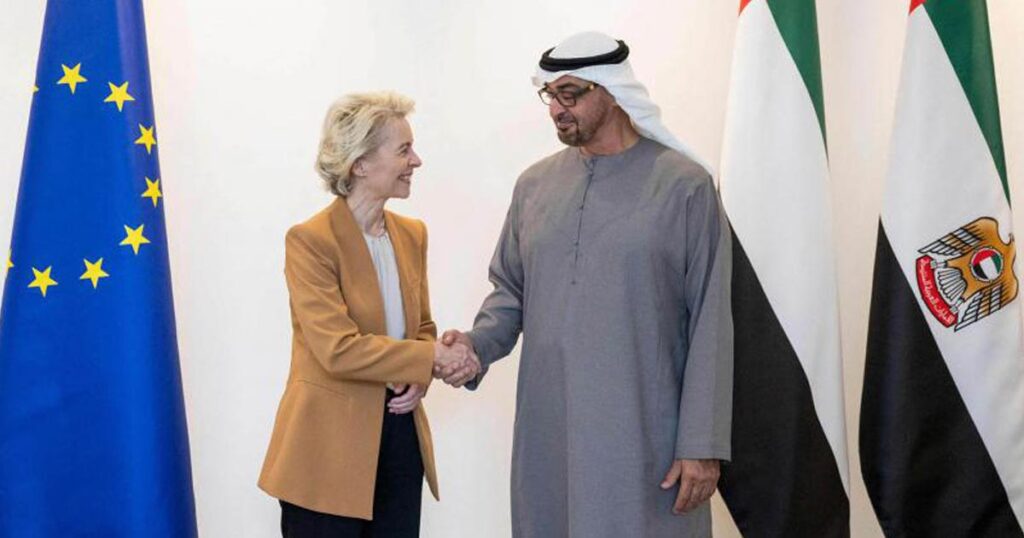
In the context of adversity and tensions that redefine commercial cooperation and economic exchanges, the European Union (EU) has recognized its vulnerabilities and dependencies and has adopted an increasingly assertive approach to trade policies, in accordance with its’Open strategic autonomy ‘ concept. Consequently, the union seeks to raise its economic cooperation at a higher level with the countries of its broader neighborhood, strategic partners with which it has shared interest and priorities that overlap on open trade. The United Arab Emirates (water) meet all these criteria.
For water, the EU is its “Second World Trade Partner», With the increase in non -oil trade shares, while for the EU, Water is a main walk For its goods and services in the Gulf and its “largest foreign direct investment partner in the region”. On the basis of their mutually beneficial commercial cooperation, and considering that “In this fragmented world, strategic partnerships are the most important currency“, The parties announced April 2025 The launch of negotiations in free trade agreement (FTA)(1).
Impact on GCC-UE FTA discussions
A bilateral Ale with an individual country of the Gulf Cooperation Council (GCC), and not with the CCG itself as a regional block, “is a departure from the historical position of the EU». Region negotiations in the region were launched almost two decades ago, but were suspended in 2008 due to the absence of a mutually acceptable agreement. However, this does not indicate a loss of interest on each side. The very first EU-GCC summit had engaged To restart the Ale talks.
Region negotiations in the region were launched almost two decades ago, but were suspended in 2008 due to the absence of a mutually acceptable agreement.
However, the EU openly declared that the bilateral agreement with the water “Can be used as a catalyst for stronger links between the EU and the Gulf Cooperation Council». Luigi Di Maio, EU special representative for the Gulf, also stressed that UE-UAE FTA represents “A construction element to a regional free trade agreement». As such, the union does not see the FTA EU-UAE and EU-GCC as exclusive. The successful conclusion of an agreement with the water, if it delivers, could provide a new momentum for region-region negotiations. The same perspective was shared by the Minister of the United Arab Emirates, Thani al-Zeyoudi, who publicly declared That the bilateral talks between the EU and the water are not an obstacle to an ALE from region to the region, but rather “a flow that will leave from here and move to the CCG”.
Preceding exist. New Zealand has concluded a bilateral trade agreement with the water a few months before finalizing a CCG level agreement. Likewise, Pakistan entered bilateral talks with the water after signing a preliminary Ale with the CCG. South Korea has signed an ALE with the GCC shortly before reaching a bilateral agreement with the water. Türkiye took the inverted path, launching CCC negotiations for almost a year after its bilateral agreement with the water. Other countries, such as Australia, Malaysia and Chile, have signed bilateral agreements with water while being in the previous stages of the pursuit of CCC levels.
Another scenario 一 A transitional route 一 which could potentially prepare the ground for a region’s ALE in the region, could materialize in several bilateral free trade agreements concluded between the EU and the individual CCG countries, alongside water. The logic of such an approach seems to gain ground within the EU, because the Council recently adopted the mandate of “Enter negotiations with each of the six countries of the Gulf Cooperation Council (CCG)” to conclude with all bilateral strategic partnership agreements (SPAS). Trade and investment would be one of the main components of these partnerships. However, complementary to spas, the potential of bilateral ALE with all CCG countries strongly depends on their economic advantages and their projected viability for the parties involved.
Remaining obstacles
While the water said, he expects negotiations to take a few months, and the EU has shown a gesture From the goodwill by removing the water from his money laundering monitoring list, obstacles remain between the two parties. The first series of negotiations between the EU and the water was detained Between June 24 and July 9 of this year. The EU had submitted proposals for the chapters of the ALE before the Tour, with the second series of negotiations planned in Brussels in September 2025.
Capitalize on his market powerThe EU used commercial negotiations to “outsource its social programs” and development, thus shaping third party policies in these areas. EU position on human rights and labor, in addition to the petroleum industry, was a key obstacle Behind the scoring of the GCC-EU FTA negotiations, for example. There remains a key problem with a new impact assessment focused on such subjects delivered by the EU on GCC-EU FTA negotiations. The same obstacle seems to reappear in the table’s text proposal by the EU to water, continuing to to focus On the commitments of human rights, work and sustainability.
Potential advantages: the analogy of the Asean-EU
The most apparent risk of an exclusive FTA EU-UAE is that it could trigger significant diversion and investments far from other CCG members. Saudi Arabia is historically the dominant exporter of the CCG to the EU. He constantly counted More than 60% of total exports of the block., These exports are highly concentrated in the same sectors as those of water. According to data from 2024, for Saudi Arabia, HS 27 code (mineral fuels, etc.) represents 85% of its exports to the EU. Likewise, while water has made progress in diversification, the HS 27 code still represents 49% of its exports to the EU.
This homogeneity in their main export property – mineral fuels – means that any preferential access granted to water for these products would have an impact directly on the competitive position of Saudi Arabia on the EU market. If the FTA considerably reduces non -pricing prices and barriers for oil and gas products, the EU is likely to increase its supply of water. This would divert trade in Saudi Arabia, which has no preferential access.
However, a more optimistic scenario exists if the agreement is structured with regional integration into the mind. On this point, an analogy could be observed and analyzed on a region which has been faced with a path similar to that of the CCG with regard to trade with the EU: the Association of Nations of Southeast Asia (ASEAN). Biégional commercial negotiations were launched in 2007 and interrupted by a mutual agreement in 2009 to give way to a bilateral format of negotiations, which were sign Between the EU and Singapore (2014) and Vietnam (2015).
The evaluation of the post-FTA trade with the EU presents an interesting story for Singapore, the figure below showing that after the implementation of its ALE in 2019, the share of Singapore of the export of the Anase refused, fall 14% to 11% by 2024. A reading at the surface level suggests that Singapore simply failed to benefit from its agreement.
However, a deeper insight helps to solve the puzzle: the “Cumulation of the Asean” The clause presents a convincing potential explanation. This clause is a specific provision within the EU-Singapore FTA which allows Singaporean companies to count the materials and components from other ASEAN countries as if they were theirs. The “Asean Cumulation” clause has two primary mechanisms which allow regional entries. Some products may be included if they come from an Anase country which has a separate preferential agreement with the EU. For other specified products, materials can come from any Asean nation, even those without direct Ale with the European Union. This provision has the potential of redefine What it means to be “manufactured in Singapore” for trade with the EU. This could explain a fascinating scheme in the data: the sustained and even accelerated growth of the exports of Malaysia (MOS), Indonesia (ID) and Thailand (TH) directly after the 2019 implementation of Singapore Ale. It is possible that the cumulative clause has created incentives for Singaporean companies to move the final assembly to these neighboring countries in order to reduce costs, while retaining control of the most profitable parts of the value chain. In this scenario, export statistics are recorded in Malaysia or Indonesia, but economic benefit returns to Singapore. The drop in the share of Singapore goods exports may not be a sign of failure, but could rather be a sign of a sophisticated strategy: it does not benefit by shipping more boxes, but by acting as the essential economic brain for a flourishing regional supply chain.

Source: Authors’ calculations using data from the Eurostat database
A “GCC” clause, similar to the Asean model, could be just as powerful in this regard. It would allow the materials of the neighboring Gulf countries to be treated with water and exported to the EU as part of the preferential terms of the ALE. This would create a powerful incentive for deeper intra-GCC supply chains. For example, Saudi gross petrochemics could be transformed into plastics specialized in advanced industrial areas of water, the two countries sharing the economic advantages of export without tariff to the EU.
In particular, such clause Lack in the proposal of EU EU EU origin rules. The only cumulative clause appears in article X.3 (original cumulation), which only authorizes bilateral cumulation between the EU and water, but not regional cumulation with third countries. The two parties can seek to consider adding this clause to ensure that the CCG scale services are collected.
Conclusion
The failure of EU-GCC FTA talks and current political differences highlight the challenges of a regional-region approach. While such discussions continue, the EU seems open to exploring bilateral agreements with individual Gulf countries. However, as the trajectory of the Anase and Singapore show, bilateral agreements, such as that which is negotiated between the EU and water, if it is strategically designed, can evolve towards wider regional gains.
This comment originally appeared in Middle East orf.
(1) The European Union uses the terminology “free trade agreement” while the United Arab Emirates refer to that of “complete economic partnership agreements” – diplomatic source.
The views expressed above belong to the authors. ORF research and analyzes now available on Telegram! Click here To access our organized content – Blogs, long forms and interviews.
About The Author