The second term of American president Donald Trump began with unpredictable strategies and blackmail, even towards long-term allies such as the EU and the United Kingdom. Historically, Republican presidents had more political attachment to India than Democratic presidents. But the current Republican president Trump displays unequal treatment towards India. Therefore, it is a difficult period for decision-makers of India-US.
Over the past two decades, since the disintegration of the USSR, the search for India for a Western partner has ended up finding the United States as its new friend. In addition, the complete inclination of India to the United States on successive administrations has made India and the United States to become strategic partners for defense, science and technology, space, trade, education and many other fields. Nevertheless, this lasting friendship has become in danger due to the first year of the current administration.
Last year, Trump wasted; There have been no big sockets in India and American relations. Reciprocal tariff threats continue and hamper a trade agreement between the two democracies. Let’s analyze how the decision -makers of India responded to the Trump administration and its impacts on relations.
The historic training of the India-US partnership in defense and technology has led New Delhi to reduce its defense purchases with Russia and to divert resources to the United States, Israel and France. This awareness of the diversification of India in the defense markets is worrying in Moscow. Russia has changed, looking for new strategies. Moscow now reaches out to China’s friend, Islamabad, the archrival of India. Without strategic thinking, the precipitous surrender of the Administration of Modi to comply particularly to the Trump administration is a serious setback of foreign policy and diplomacy of India. India should understand that any proximity to the United States should not be at the cost of Russia.
In this current scenario, India is faced with many challenges. Trump firmly threatens BRICS nations – including India – with additional prices. The presidents of China and Russia did not attend the Summit of the BRICS in Brazil. While India’s policy pushes New Delhi near Washington, China and Russia are close to the shadow of the Russian-Ukraine war. Thus, India is in a situation where it is unable to take advantage of its relations with the United States or Russia.
Meanwhile, India did not have a say in the negotiation led by Saudi Arabia in Riyadh between the United States and Russia to end the Ukraine War in March 2025. This is the case despite the proximity of New Delhi to Moscow and despite India able to boast of the Fourth World Economy of the GDP. The United States has sentenced the recent terrorist attack to Pahalgam but did not mention Pakistan. Following Operation Sindoor, the ceasefire between India and Pakistan was bilaterally made, even after Modi declared that no third party was involved in the war. However, Trump said on several occasions that it was his intervention which had ended the conflict between the two nuclear powers. This clearly shows the diplomatic weakness of India in strengthening the position of India.
George W. Bush’s doctrine had to deceive American policy between India and Pakistan during the era of Dr Manmohan Singh. However, since 2016, this has been gradually in the beach under the administration of Modi. India and Pakistan are often combined in a single sentence in Trump’s political speeches. The treatment of India and Pakistan is also a crazy decision for the United States to enjoy its relations with India. Here, India cannot thwart Trump’s approach. In addition, the Pakistani military general Asim Munnir was invited by Trump to the White House. This was also against India’s wish.
Meanwhile, China looks very closely at the current bilateral negotiation between India and the United States, delays to obtain an agreement between the two countries is a concern for business leaders of India. Trump suggested a tariff of 26% for India in April and a 90 -day suspension on reciprocal prices from July to August 1 for its business partners, including India. However, Indian political decision -makers believe that New Delhi should not be treated in this way by Washington. It is very clear that the two democracies have solid bilateral links in various fields, but this is a disappointing news for New Delhi that there is no price exception for India under the Trump administration. However, Trump said the United States would soon have a trade agreement with India. In addition, the recent action of adding the “strength of resistance” (TRF) to the terrorist list by the United States for the Pahalgam strike is a bit of comfort for India diplomacy.
However, increasing tensions in the Middle East, the Ukrainian Russian war endless and the threatening price of Trump make the international system more complex and vulnerable. In addition, the interest of the president of Burkina Faso Ibrahim Traore for Russian relations concerns France and the EU. In addition, the inexpressible links of Russia-China and a new direction in Russia-Pakistan are a new headache for India.
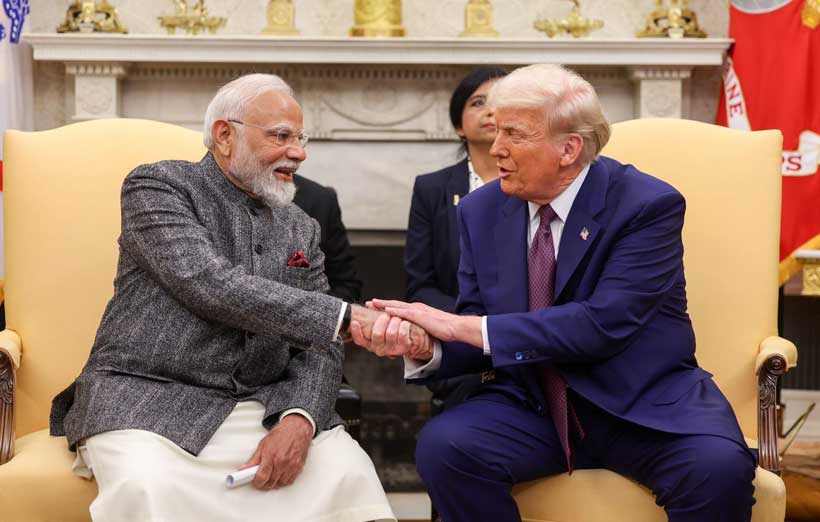
India-US relations during the first year of the Trump administration were wasted in the midst of helping hands and installation for media bites. Modi’s hasty meeting with Trump in February of this year could have been avoided. Dr. Subramanian Swamy said that “Modi has made a very bad choice to go to the United States to meet President Trump at this stage.” If India had postponed the Prime Minister’s visit to the United States, it would have given a lever effect to New Delhi to negotiate a trade agreement with Washington. Xi Jinping or Vladimir Putin never rushed to meet the American president.
After the meeting with Modi, Trump repeatedly said that India’s pricing policy was not acceptable. Unlike his predecessors, billionaire Trump does not treat India as an equal partner. India’s response to Trump is also diplomatically weak. Thus, it is difficult to see how the two countries will advance under the Trump administration for the next three years.
About The Author