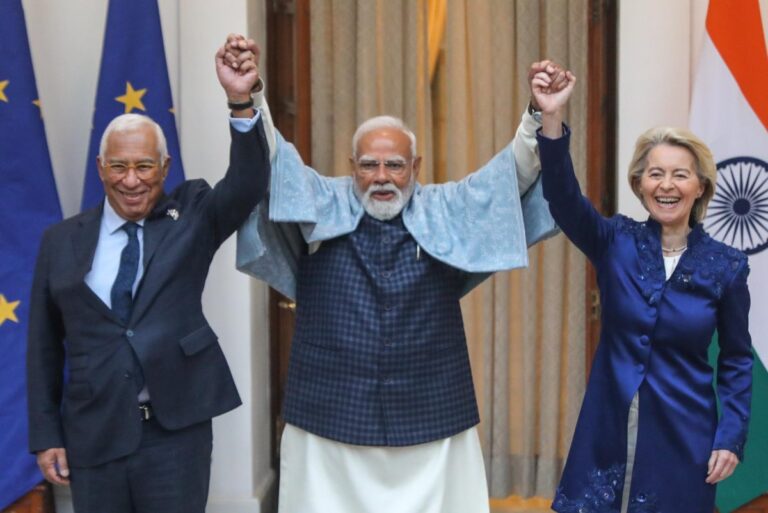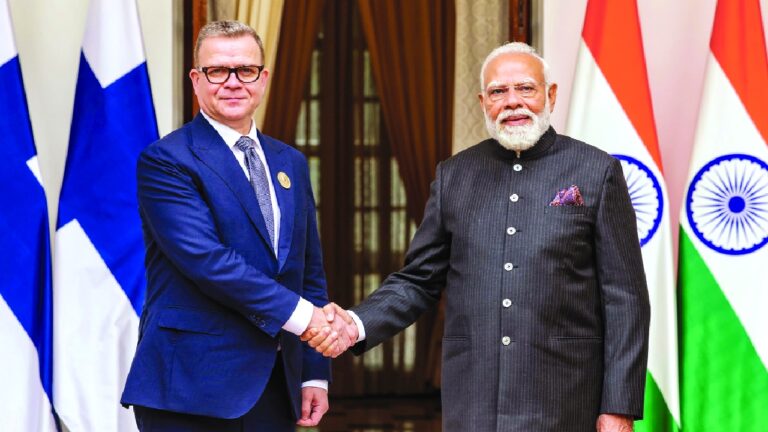
In a world increasingly marked by disorders and divergence, while the mavens of foreign policy have thrown new political initiatives, the India -Europe relationship is a convincing case for diplomatic renewal – anchored in civilizational depth, but animated by contemporary relevance. If history has often given them distant participants in the geopolitical imagination of the other, the present moment requires – and allows – a more determined commitment.
The G-7 diplomacy of Prime Minister Narendra Modi and the Minister of External Affairs, S. Jaishankar, the renewed concentration on Europe reflects a conscious pivot towards a continent in flow. It is not simply recognition of the economic or sustainable cultural capital of Europe; This is a clever reading of the world’s developing world scheme, where the alliances of yesterday ficed, and new solidarities emerge through hemispheres.
An upset order, an emerging partnership
The transatlantic domain, long anchored by American leadership, finds itself drifting in the middle of the iconoclasm of the President of the United States Donald Trump. His transactional vision of the world, skepticism towards the organization of the North Atlantic Treaty, disdain for traditional allies, and dialing with adversaries such as Russian President Vladimir Putin have upset the most constant partners of Washington. The G-7, formerly the de facto board of directors for global governance, convened last month not in consensus, but in the running.
For Canada, the United Kingdom, Germany and France – each recalibrating their foreign policies – the strategic logic of research to EST has become clearer. Canada, disentangling over-dependence in the United States, is now looking for more in-depth integration with Europe and emerging powers such as India (hiccups on its mollycodding of Khalistanian extremists despite). The United Kingdom, which allowed its illusions of the Brexit era, embraces renewed continental links. And Germany, awake from strategic drowsiness, embarked on a defense and industrial reinvention investment pathway. In this environment, Europe endeavors not only to remain relevant, but to become a post of power in its own right.
The rhetoric of “strategic autonomy”, once French, is now resolved in Berlin, Warsaw and Brussels. From the nuclear umbrella of the French president Emmanuel Macron to the constitutional recalibration of Germany for military spending, and the assertion of the Weimar triangle in Central Europe, the European reinvention project is on track.
The external commitment of India, long characterized by prudence and non-alignment, is transformed into a more assertive posture of “multi-alignment”. In a world that lights up towards bipolar rivalry between the United States and China, India and Europe, the two ambitious medium powers find a common cause in the champion of a multipolar order which is anchored in international law, inclusive institutions and plural values. This convergence takes place on several fronts. The European Indian Union (EU) commitment now takes place at two levels. Institutionally, the EU and India expand their long -standing dialogue in shared and exclusive – trade and technology and climate change fields. Bilaterally, links with the main Member States – France, Germany, Italy and, more and more, the Nordic and Eastern European nations – acquire a greater strategic depth.
Economic ties as a corridor of the opportunity
Few statistics capture the potential of this moment better than the surprising increase in trade and bilateral investments. Between 2015 and 2022, direct foreign investments in EU in India increased by 70%, French investments with 373% of France. Over the past three years, imports from the EU from India have doubled, highlighting the growing economic magnetism of New Delhi. However, India and Europe only scrape the surface.
Highly anticipated Indian trade and investment agreements must now be accelerated with an “early harvesting” agreement which shows a certain sensitivity to the green transition of India. The European adjustment mechanism of the carbon border, commendable in the mind, must be reinterpreted through the objective of equity. Climate ambition should never become climate protectionism. The economic corridor of East-Europe India (IMEC) can become a modern silk route connecting geographies not only in trade, but also in business, energy and innovation. This is a response to the infrastructure demand for the Indo-Pacific which is transparent, sustainable and sovereign in the mind.
The most exciting border is perhaps in technology. India and Europe both consider the digital architecture not as an area owner of Big Tech, but as public infrastructure for the world good. As Mr. Modi observed it during the AI action summit, the partnership can extend over the entire digital life cycle – from innovation to governance, from standards to regulation. Europe’s leadership in deep technology, digital manufacturing and semiconductors contributes to India’s dynamism in software, digital public goods and scalable platforms. Together, they can lead in clean energy innovation, biotechnology, sustainability of oceans, food security and resilient health care systems.
To exploit this, both parties must invest in human mobility. A full mobility agreement for students, scientists and academics will enrich talent basins, will facilitate Indian unemployment and fertilize bilateral innovation. In the era of ideas, cross -border thinkers are as precious as cross -border capital.
Strategic alignment now extends to defense and the fight against terrorism. Europe remains an important source of armaments for India, and as the two parties are looking for self -sufficiency – India under Atmanirbhar Bharat, Europe at Rearm 2025 – there is a range for co -development and unprecedented technology transfer. Maritime cooperation, cybersecurity, space collaboration and joint terrorism responses offer a model of confidence. Europe must also adopt a firmer line on Pakistan activation of Islamist extremism – a problem that has marked both sides. Technical cooperation is not enough; The political will must follow.
In a world where the great powers often behave as if could be good, the intermediate powers such as India and Europe must act as guards of an order based on the rules. Not like relics of a liberal utopia, but as realists who continue stability through coalitions, no coercion. Their shared belief in multilateralism, by resisting hegemonic binary and empowering the world South with inclusive frameworks, distinguishes them from more normative paradigms. This ethics must shape their spouse leadership in the United Nations forums in the World Trade Organization (WTO) and the Quad (Australia, India, Japan, United States) to the Governance Tables of Artificial Intelligence (AI).
Change minds, not just politicians
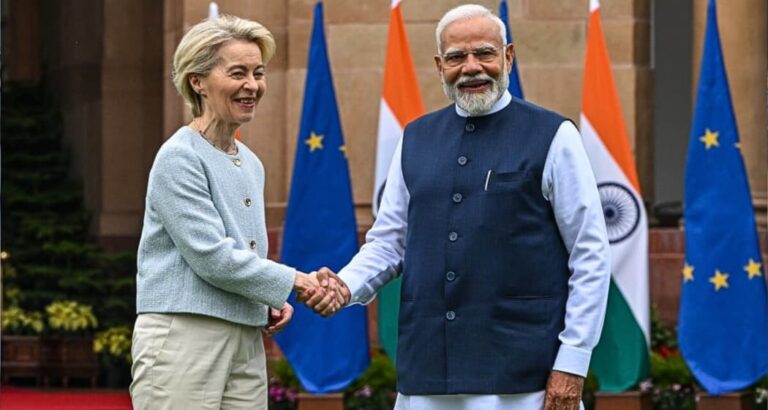
Finally, let us not underestimate the power of perception. Public feeling, media accounts and political attention must align with strategic intention. Relations prosper not only by summits and statistics, but by empathy, imagination and sustained efforts. Europe must go beyond the stereotypes of India as a reluctant partner; India must assess the complex transitions of Europe with a greater nuance. The Dialogue Raisina in Marseille (June 2025), the president of the European Commission, the symbolic visit of Ursula von der Leyen in Delhi (February 2025), and the diplomatic investment of India in the Mediterranean and Nordic regions, are all promising stages.
If the last decade has taught us that history has a sense of humor (think of our relationships with the two iterations of the Trump administration), the next one requires that we have a sense of goal. India and Europe, which have launched a long time, must now walk knowing that their shared values and their strategic compulsions form a partnership not of convenience, but of conviction. Because each other, they can not find a mirror, but a window on a more stable, inclusive and fair world.
Shashi Tharoor is a former under-secretary general of the United Nations, a fourth mandate deputy (congress), Lok Sabha, for Thiruvanthapuram, president of the parliamentary permanent committee of external affairs, and the Sahitya Akademi Akademi Award of 27 pounds, including books, including books, including books, including books, including books, Including books, including 27 pound books, the Sahitya Akademi Prize of 27 pounds, including books, including books, including books, including books, including books, including books, including books, including books, including external books of Sahitya Akademi PAX INDICA: India and the 21st century world (2012)
About The Author