One of the engines of the EU and India to strengthen links – the economic development of China – is also one of the main obstacles to the deeper integration of the EU -India.
In recent months, European and Indian officials have not done much to hide the fact that, with the “America First” policies of the American president Donald Trump, a shared hint of Beijing is a key factor in their effort to deepen political, commercial and investment links.
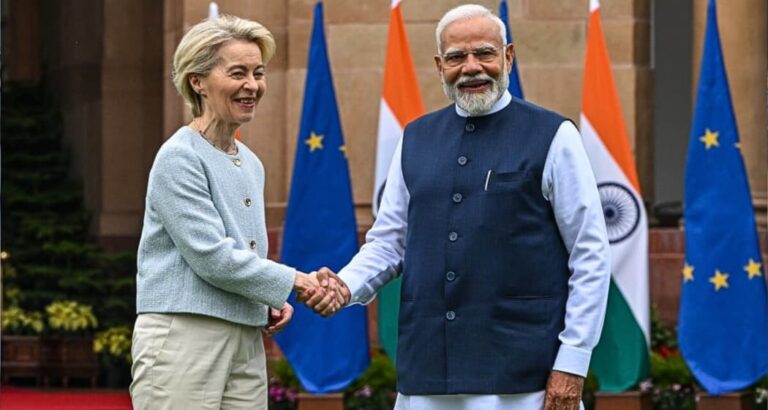
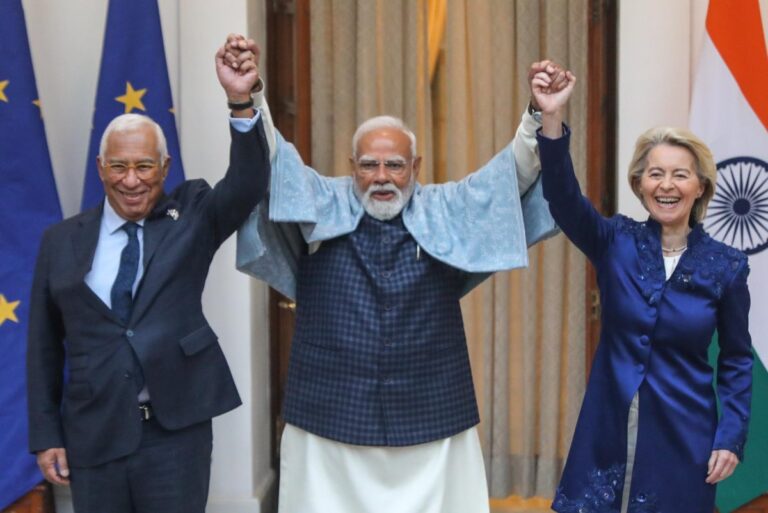
During visit In New Delhi earlier this year – the first official trip of the new European Commission – Ursula von der Leyen said that “geopolitical and geo -economic opposite winds” offer “a historic opportunity to build an indivisible partnership between Europe” and the fifth world economy.
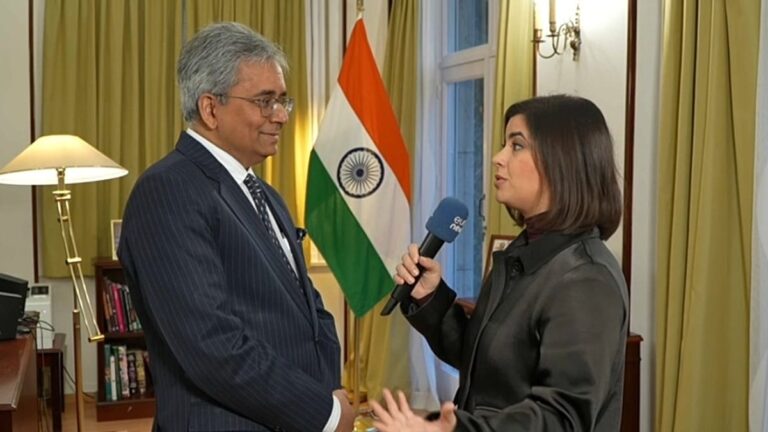
Likewise, the Indian Minister of Foreign Affairs, S. Jaishankar, told Euractiv earlier this week than the thrust of European companies to “risk their supply chains” should encourage both parties to deepen trade links. Brussels and New Delhi aim to win a long-term free trade agreement by the end of this year.
Analysts warn, however, that the thrust of Europe to reduce its strategic dependence on Beijing by pivoting the South is facing many obstacles, in particular the relatively low industrial development of India, the high levels of protectionism and excessive bureaucracy.
“Can India replace China? The short answer is not – at least not in the short term,” said Niclas Poitiers, researcher in Bruegel, a reflection group based in Brussels.
This assessment is corroborated by a plethora of recent studies, forecasts and data.
Eu-India Trade is currently just a fifth as important as annual Eu-china Exchanges in goods and services, despite having increased by more than 90% to 180 billion euros over the past decade.
India has exceeded China to become the most in the world populated nation Two years ago, but India’s GDP remains well below a quarter the size of its north neighbor.
Goldman Sachs Also estimated that the production of India will be always smaller than that of China in 2075, even if it quickly exceeds the current growth rate of Beijing.
‘China is too well rooted’
It is unlikely that China will give up its status as Manufacturing superpower Anytime soon. The second world economy currently represents around 80% solar panel Production and approximately 90% of all treatments of supposedly “rare».
According to For the United Nations Industrial Development Organization, the share of India in global industrial production will drop from just under 2% today to around 3% by 2030; The Chinese portion, on the other hand, is expected to drop from 30% to 45%.
Sony Kapoor, CEO of Nordic Institute for Finance, Technology and Sustainability, said that New Delhi’s push by a decade to stimulate national manufacturing through the very valor of Prime Minister Narendra Modi “Made in India“It is unlikely that the initiative is threatening the global industrial domination of China.
“I don’t think India will be the next manufacturing leader in the world,” he said. “It is too late – China is far too well rooted.”
Kapoor, originally from India, added that “there are several very good reasons – commercial, financial, security and geopolitics – to deepen the EU -Indian relationship”, emphasizing the potential mutual benefits of the integration of millions of well -educated Indians and underemployed in economically productive services in the greatest global democracy.
“But if that (the integration of the EU-Indian) is from the EU point of view mainly as a way to deactivate China’s supply chains, then the EU is likely to be disappointed,” he said.
Analysts warn that even if the EU had to conclude a full -fledged trade agreement with India by the end of 2025, this would still not be able to approach the high levels of New Delhi with third countries, which limits its ability to stock up with key components and increase the global value chain.
Poitiers, Bruegel’s researcher, said that India’s development model was important in China, insofar as the latter is more open to the supply of components for its manufactured products from other Eastern Asian countries.
“The question of the billion dollars is: is India finally ready to open up to the world?” He said.
‘Two different galaxies’
The deeply rooted protectionism of New Delhi has also caused commercial negotiations between India and the EU to strike several road dams in recent months, according to the EU and industry officials.
“It is quite obvious that we are not going to finalize a full-fledged free trade agreement to the New Zealand with India in the next 10 months, “said Christophe Kiener, the chief negotiator of the block in MEPS in March, adding that the two parties had addressed certain commercial problems of” two different galaxies “.
Agriculture remains the largest stumbling block. Brussels wants better access to the market for its food and drinks, but India – whose agricultural sector represents 16% of its GDP and employs almost half of its workforce – insists on maintaining high import samples.
One of the main priorities of the EU is to force India to reduce its duty by 150% on minds. Here, there are signs that New Delhi’s position could soften: the country has recently reduced prices on Gin and British tape by 150% to 40% over 10 years, with similar movements for American Bourbon. An industry source also told Euractiv that the negotiations on the spirits are now “quite positive”.
However, there are several main discussions linked to food.
India has would have Put the dairy products – a major export of the EU – outside the table for negotiations. The EU Commissioner for Agriculture and Food Christophe Hansen has warned that if India will not open its dairy market, Europe could also reject growing quotas for sugar, key Indian export. But the sources of the dairy industry remain full of hope. “We hope there will be a chapter on dairy products,” told Euractiv.
Automobiles are another major flash point. The EU is push For zero prices on car imports – a bold request given the current price + current of New Delhi.
A potential sign of hope is the fact that the United Kingdom was able to accept a 10% levy on car exports in its Recent trade agreement with India. But the opening of the block of 27 countries, in particular for Germany, a car power plant, could constitute a major threat to the India national cars industry, in particular its growing sector of electric vehicles.
The last critical discord is the EU green rules book. India wants a special treatment within the framework of historical climatic policies such as the carbon border tax (CBAM), which could cause Indian exports to the block to deal with steep samples.
Jaishankar told Euractiv this week that India still had “very deep reserves” about CBAM. “We were quite open to this,” he added.
About The Author