The year 2025 is an active year for India in its commitment to free trade agreements (ALF). There are several FTAs that India is currently negotiating.
The discussions of the most ambitious and extensive Ale in India continue with the European Union (EU). The EU-India FTA is at an advanced stage of negotiations and is expected to end later this year. Before that, an interim agreement is expected to be announced in July 2025. India also finalized A Ale with the United Kingdom (United Kingdom) May 6, 2025. With these two FTAs, he negotiated a Bilateral trade agreement (BTA) with the United States (United States).
In addition to these three major FTAs, there are several other ALE that India began to negotiate this year. These include FTA with New Zealand And Chile. There are also ongoing negotiations with Oman and the Gulf Cooperation Council (GCC). India is also working on upgrading its existing FTAs with Asean And Sri Lanka. The FTA that India has signed with the Eft The group of countries (Iceland, Liechtenstein, Norway and Switzerland) will become operational this year. The recent thaw of relations between India and Canada Should also see the two countries accelerating their bilateral Ale for a long time.
Among all AFT negotiations that India undertakes, the United States, the United Kingdom and the EU are particularly important. This is because it is among The first Ale of India with the advanced industrialized nations located on both sides of the Atlantic. These FTAs are also with Major savings G7. Indeed, among this last group, the only existing ALE in India at the moment is the only Asian member of the G7, which is Japan. But the American, British FTA and the EU will formalize bilateral trade agreements based on India rules with several other G7 members, such as the United Kingdom and the United States; And with Germany, France and Italy through the EU FTA. The only country in the G7 with which India will remain without Ale is Canada.
New Delhi-USA: a bumpy negotiation path
The American trade agreement must be examined in a different context of FTA with the EU and the United Kingdom. India and the United States were very close to the training of a bilateral trade agreement during the first term of President Trump (2017-2020). But he did not return during the presidency of Biden, ostensibly due to the The reluctance of the Biden administration to engage with the FTA. However, during the presidency of Biden, India was proactively committed to negotiating the Indo-Pacific economic framework (IPEF), including the United States and several of its strategic and allies partners of the Indo-Pacific Region. IndiaHowever, Avoid negotiating commercial problems at IPEF And engaged in the rest of the agreement (for example, supply chains, clean economy and fair economy).
After President Trump Assumed office in January 2025, a bilateral trade agreement between the United States and India was back on the table. India was one of the first countries with which the United States announced that it would negotiate an ALE. Indeed, the announcement came long before the announcement of reciprocal prices by the United States in April 2025. But as negotiations with the United States took place, other problems appeared in the context. These include Indian-Pakistan conflict And President Trump’s claim to have mediated a ceasefire. India has repeatedly denied the complaint. There is no doubt, however, that the problem generated Some friction in the Indo-Us relationship, which have otherwise in-depth and widened over the years. The possibility that friction spreads in commercial negotiations cannot be excluded. It is even more in the event of potentially the United States location “Security guarantee” as an India concession extraction tool in negotiations.
Go ahead with Europe
The above complications, however, do not exist for the FTA of India with the United Kingdom and the EU. The Ale of India with the United Kingdom was welcomed with great enthusiasm by the two parties. The United Kingdom has expressed its satisfaction both on complete price reductions for its exports to the Indian market, as well as access to its service providers. India, on the other hand, described the agreement as “historical and ambitious”. His expectations of the ALE are identical to those of the United Kingdom, insofar as obtaining good prices discounts on several exports and market access gains for its services exports is concerned.
For India, a significant advantage of the British Ale is the exemption which must be authorized to temporary Indian workers and their British employers to pay social security contributions for three years. This brings India equally with other countries with which the United Kingdom has similar exemption agreements. In a broader sense, it will be great importance for many Indian IT companies (For example, Infosys, Wipro) who serve their British customers via digital services and on site, and who will now be able to recruit Indian workers based in the United Kingdom without paying additional social security costs. This will also benefit other eminent Indian industries in the United Kingdom, as in automobiles (for example Tata Motors, Mahindra) and drugs (for example Dr Reddy’s, Cipla).
The Starmer government in the United Kingdom and the Modi government in India accelerated the United Kingdom for a Rapid conclusion. One of the common objectives in this regard was the intention of ensuring that the Indian and British goods and services obtain preferential access to the other markets on the basis of exclusive rules of the bilateral ALE – regardless of what is happening in its commercial negotiations with the United States. The two parties negotiated trade agreements with Washington, while finalizing their bilateral Ale. Another important point to note in this context is that, despite the importance of the United States for India and the United Kingdom as a geo-strategic and economic partner, They are both aware of the disruptive nature of current American trade policy. This is a strong incentive to develop commercial preferences in a regulatory framework which is not surrounded by the “influence” of the United States.
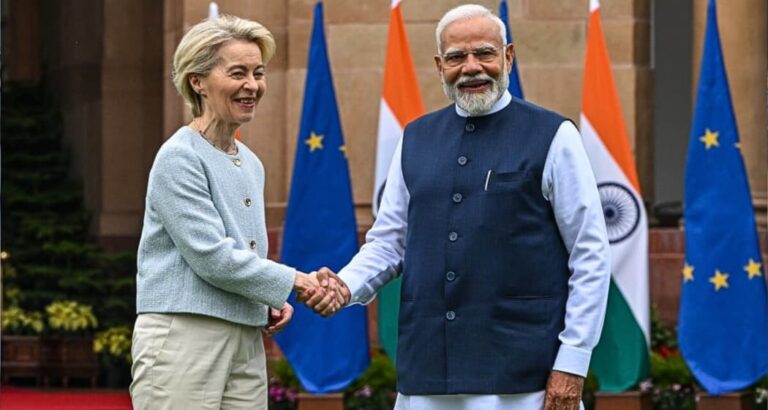
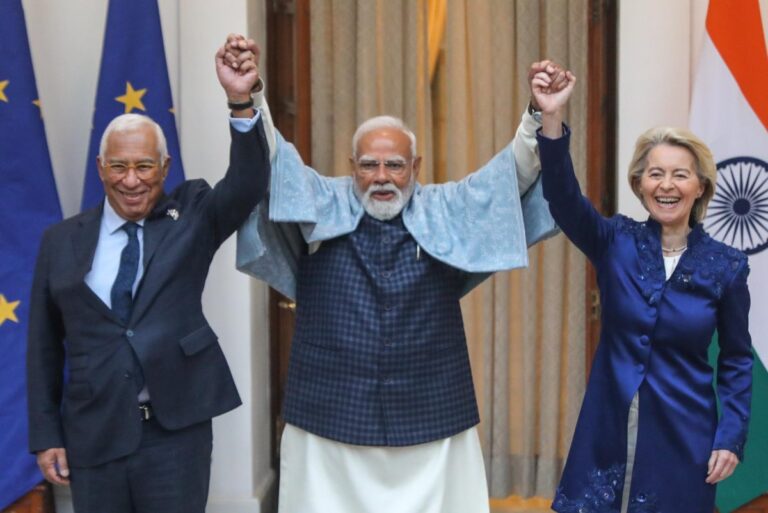
India negotiations with the EU are also encouraged by similar motivations. In this regard, it is important to note that India and the EU have introduced a New political emergency In their negotiations earlier this year. This was obvious during the president of the European Commission’s visit to India at the end of February 2025. Such an emergency was not seen in the negotiations earlier, which has been taking place for several years now and was sometimes blocked. In this regard, Trump 2.0 seems to have played a decisive role in accelerating negotiations.
In many ways, The Ale of India with the EU should include the “new” provisions which are there in its Ale with the United Kingdom. In addition to deep price cuts in food and drinks exports, as well as on cars, including electric vehicles, India has shown the audacity of the offer significant access to some of its historically protected national services. These include British companies to compete with government supply contracts. In addition, India and the United Kingdom have also agreed to authorize their respective professional service agencies to determine the mutual recognition of professional qualifications, which could be an indication of India’s intention to liberalize some of its professional services markets (for example, accounting, legal).
India-EU FTA still owes Cross the important obstacles of the finalization of regulations for the transfer of cross -border data, the prior authorization of service providers based on data, investment facilitation and the carbon border adjustment mechanism (CBAM). None of these elements is an easy problem to solve and agree. Some of them are likely to be treated in the next phase of negotiations. Currently, the EU and India seem to wish to announce the first phase of a bilateral agreement, commonly known as “early harvest”. Even if it is an interim agreement, the intention of the two parties to put their trade and investment relations in the field of a bilately agreed structural framework of an ALE will be an important strategic and economic realization.
About The Author